
Free vs. Paid Credit Report Access: What You Actually Get With Each

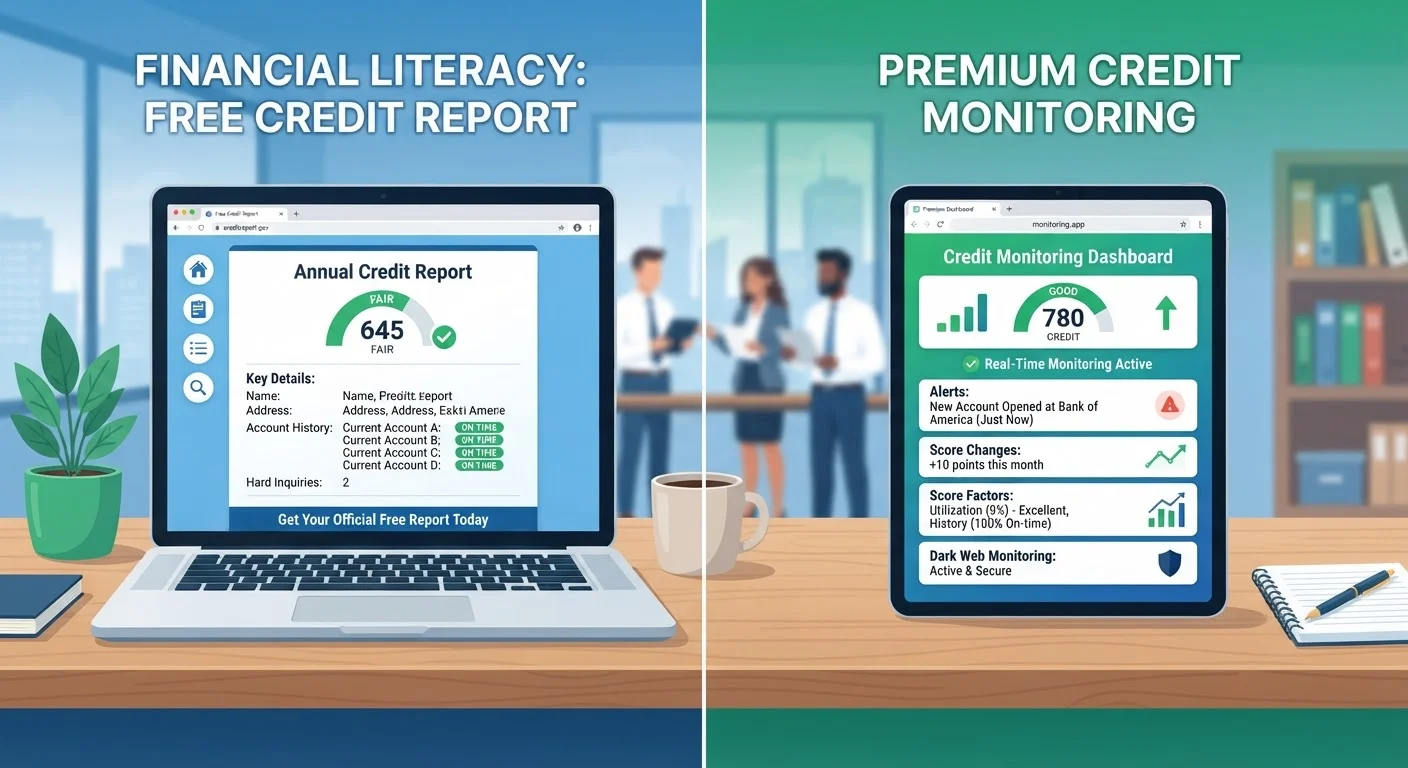
Photo: MoneyOnMind.net | Navigate Money With Clarity editorial
Key Takeaways
- Federal law entitles every American to free credit reports from all three major bureaus weekly at AnnualCreditReport.com.
- Free access gives you the full report data - the same underlying information paid services use.
- Paid services add real-time alerts, score tracking, and identity theft protection, not more report content.
- Most beginners can meet their monitoring needs without a paid subscription.
- Reviewing your reports regularly - free or paid - is one of the most effective credit habits you can build.
Full report data at no cost, legally guaranteed
AnnualCreditReport.com provides complete bureau files under federal law - not partial previews. You see every account, inquiry, and public record without paying anything.
Weekly access keeps information current
Since 2023, free weekly reports give consumers near-real-time visibility into their files, substantially reducing the monitoring gap that once made paid services more attractive.
Paid alerts catch changes before you notice them
Automated notifications for new accounts or sudden balance changes can surface fraud within hours rather than weeks, which is a meaningful advantage for anyone who has been a previous identity theft target.
Three-bureau dashboards simplify comparison
Lenders may report to one, two, or all three bureaus differently. A unified paid dashboard makes it easier to spot discrepancies across bureaus without logging into three separate free portals.
Identity theft insurance provides financial safety net
Some paid plans include coverage for costs incurred while resolving fraud - legal fees, lost wages, and certain financial losses - which free access does not offer.
Free reports require manual, self-directed monitoring
Without automated alerts, you need to proactively pull and review your reports on a schedule. Errors or fraudulent accounts can go undetected between review sessions.
Free access typically excludes credit scores
Bureau reports obtained for free do not bundle a FICO or VantageScore. You will need to source your score separately, though many bank and card accounts now offer this at no charge.
Paid services add ongoing monthly expense
At $10-$40 per month, a paid monitoring subscription costs $120-$480 annually - a real budget consideration for young professionals already managing debt repayment.
Paid plans may duplicate existing free benefits
If your credit card already provides free score access and fraud alerts through your issuer, a third-party paid service may largely duplicate what you already have.
Dark web scanning has limited practical impact
Knowing that your data appears in a breached database is useful, but the action steps - freezing your credit, changing passwords - are the same regardless of whether you pay for the alert or discover it another way.
What Free Credit Report Access Actually Gives You
Under the Fair Credit Reporting Act (FCRA), every U.S. consumer is entitled to a free credit report from each of the three major bureaus - Equifax, Experian, and TransUnion - through AnnualCreditReport.com, the only federally authorized source. Since 2023, those free reports have been available weekly, not just annually.
What do you actually receive? A complete snapshot of your credit file, including:
- Personal identifying information (name, addresses, employers on record)
- All open and closed credit accounts with balances, limits, and payment history
- Hard and soft inquiry records
- Public records such as bankruptcies
- Collections accounts
That is the full report - not a summary, not a teaser. To understand every line item in that file, see what a credit report actually contains.
One important note: free bureau reports do not automatically include your credit score. Scores are a separate product. However, many credit card issuers and banks provide free FICO or VantageScore access through your existing account dashboard, which fills that gap for most people at no extra cost.
Credit Freezes Are Always Free
What Paid Services Add to the Picture
Paid credit monitoring services - typically priced between $10 and $40 per month - layer additional features on top of the same underlying bureau data. They do not give you a richer or more complete report; the raw information is identical. What they offer instead is convenience, speed, and automation.
3
Free reports available per week
Since 2023, AnnualCreditReport.com has made weekly free reports from all three major bureaus a permanent entitlement under expanded CFPB guidance.
~$240
Average annual cost of paid monitoring
Mid-tier paid credit monitoring services typically range from $10 to $30 per month, placing the average annual spend around $120-$360 depending on the plan.
Key extras that paid tiers commonly include:
- Real-time or daily alerts when new accounts are opened, balances change significantly, or inquiries are recorded in your name
- Continuous score tracking across multiple scoring models, often with charts showing score history
- Three-bureau monitoring in a single dashboard, versus checking each bureau separately for free
- Dark web scanning for your personal information in data breach databases
- Identity theft insurance and dedicated resolution support, sometimes covering up to $1 million in losses
These are legitimate benefits, but they are tools for convenience and response speed - not access to information you otherwise could not see. If you are diligent about manually checking your free reports on a rotating schedule throughout the year, you can replicate much of the monitoring function yourself. Building a year-round monitoring habit walks through exactly how to do that.
Pros and Cons at a Glance
Understanding the tradeoffs helps you choose the access level that fits your current situation, not just the most feature-rich option.
Full report data at no cost, legally guaranteed
AnnualCreditReport.com provides complete bureau files under federal law - not partial previews. You see every account, inquiry, and public record without paying anything.
Weekly access keeps information current
Since 2023, free weekly reports give consumers near-real-time visibility into their files, substantially reducing the monitoring gap that once made paid services more attractive.
Paid alerts catch changes before you notice them
Automated notifications for new accounts or sudden balance changes can surface fraud within hours rather than weeks, which is a meaningful advantage for anyone who has been a previous identity theft target.
Three-bureau dashboards simplify comparison
Lenders may report to one, two, or all three bureaus differently. A unified paid dashboard makes it easier to spot discrepancies across bureaus without logging into three separate free portals.
Identity theft insurance provides financial safety net
Some paid plans include coverage for costs incurred while resolving fraud - legal fees, lost wages, and certain financial losses - which free access does not offer.
Before committing to a paid plan, it is worth addressing a common misconception: checking your own credit report - free or paid - does not hurt your score. That is a soft inquiry, which has no impact. Common myths about credit reports covers this and other persistent misunderstandings that hold people back from checking at all.
Free reports require manual, self-directed monitoring
Without automated alerts, you need to proactively pull and review your reports on a schedule. Errors or fraudulent accounts can go undetected between review sessions.
Free access typically excludes credit scores
Bureau reports obtained for free do not bundle a FICO or VantageScore. You will need to source your score separately, though many bank and card accounts now offer this at no charge.
Paid services add ongoing monthly expense
At $10-$40 per month, a paid monitoring subscription costs $120-$480 annually - a real budget consideration for young professionals already managing debt repayment.
Paid plans may duplicate existing free benefits
If your credit card already provides free score access and fraud alerts through your issuer, a third-party paid service may largely duplicate what you already have.
Dark web scanning has limited practical impact
Knowing that your data appears in a breached database is useful, but the action steps - freezing your credit, changing passwords - are the same regardless of whether you pay for the alert or discover it another way.
The word "free" in financial products can sometimes obscure real costs, as explored in articles about what "free" checking accounts actually mean. In this case, however, free credit report access is a legal entitlement with no hidden conditions - no account required, no credit card needed.
This article is for general informational and educational purposes only and does not constitute personalized financial, legal, or credit advice. Consult a qualified financial professional for guidance specific to your situation.
The content on this site is for informational purposes only and is not a substitute for professional advice. Always consult a qualified professional for guidance specific to your situation.