
APR vs. Interest Rate: Why the Difference Can Cost You More Than You Think

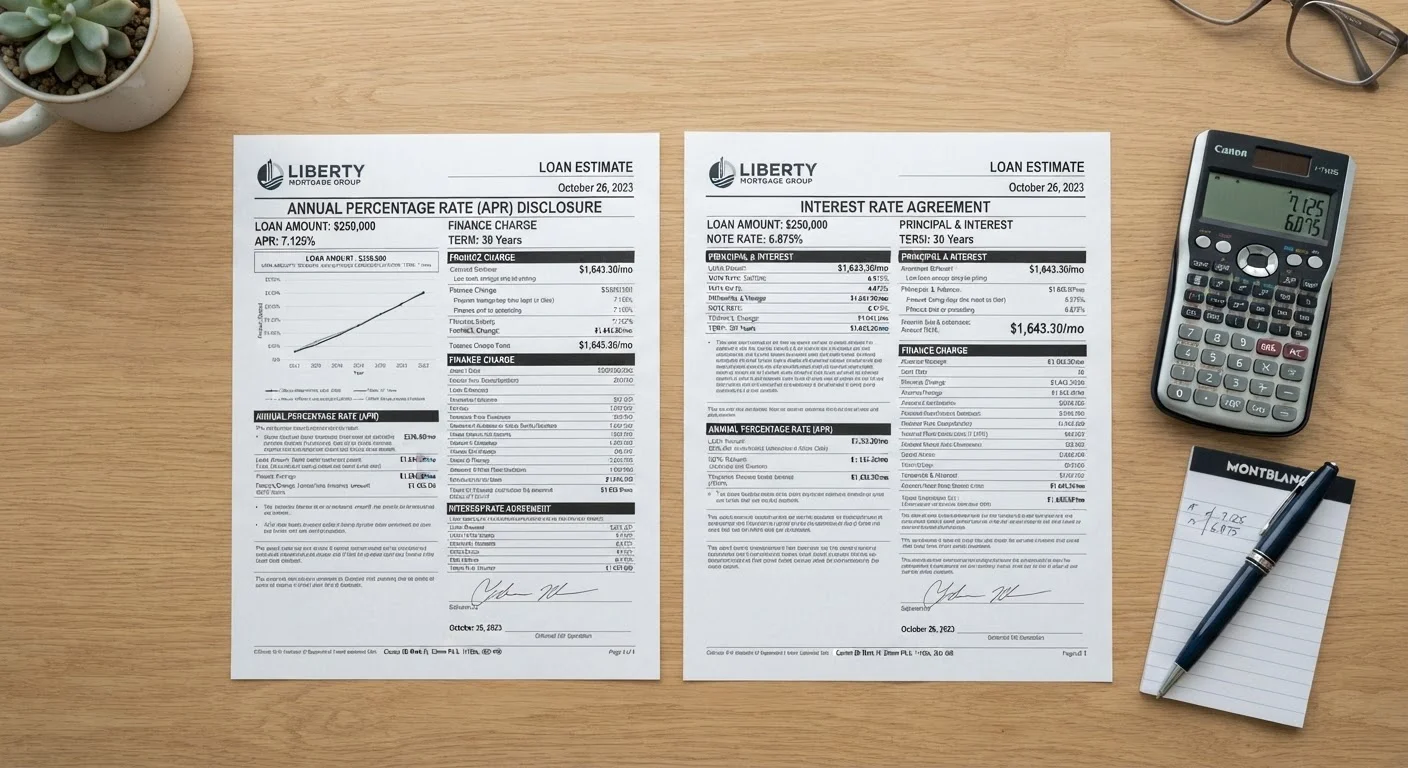
Photo: MoneyOnMind.net | Navigate Money With Clarity editorial
Key Takeaways
- The interest rate reflects only the cost of borrowing the principal, expressed annually.
- APR includes the interest rate plus most lender fees, giving a more complete cost measure.
- A loan with a lower interest rate can still be more expensive than one with a higher rate but lower APR.
- APR is most useful when comparing loans with similar terms and repayment lengths.
- Always check both figures - and read the fee schedule - before accepting any loan offer.
What Each Figure Actually Measures
When you receive a loan offer, two percentages usually appear: the interest rate and the APR (Annual Percentage Rate). They look similar, but they answer different questions.
The interest rate is the annual cost of borrowing the loan principal - the raw price the lender charges for lending you money. If you borrow $10,000 at a 6% interest rate, that rate determines how much interest accrues each year on the outstanding balance. It does not account for any fees associated with setting up or servicing the loan.
The APR takes the interest rate as its starting point and then folds in most of the additional costs a lender charges - origination fees, broker fees, discount points on mortgages, and certain closing costs. The result is expressed as a single annualised percentage, making it a broader measure of what borrowing actually costs you over the loan's life.
For a plain breakdown of how lenders construct these charges, see our guide to the real cost of borrowing.
| Criterion | Interest Rate | Annual Percentage Rate (APR) |
|---|---|---|
| What it measures | Cost of borrowing the principal only | Interest rate plus most lender fees |
| Includes origination fees | No | Yes (typically) |
| Used to calculate monthly payment | Yes | No |
| Best for comparing loan offers | Limited - ignores fees | Yes - standardised basis |
| Disclosed under TILA | Yes | Yes (mandatory) |
| Affected by loan term length | No | Yes - fees spread across term |
| Reliable on short-term loans | Yes | Can be misleading - fees annualise high |
Why the Gap Between Them Matters
The difference between a loan's interest rate and its APR is a direct signal of how fee-heavy that loan is. A small gap - say, 5.0% rate vs. 5.2% APR - suggests relatively modest lender fees. A large gap - 5.0% rate vs. 7.8% APR - means significant upfront costs are baked into the deal.
0.5%-3%
Typical origination fee range on personal loans
The Consumer Financial Protection Bureau notes origination fees on personal loans commonly range from 0.5% to 3% of the loan amount, directly widening the gap between interest rate and APR.
Up to 0.25%
Difference rate vs. APR on a no-fee mortgage
On a straightforward mortgage with minimal lender fees, the spread between the quoted interest rate and APR is often less than 0.25 percentage points.
400%+
APR on some short-term payday loans
The CFPB has documented that annualising the fees on two-week payday loans frequently produces APRs exceeding 400%, illustrating how APR can distort cost perception on very short loan terms.
This distinction becomes critical when comparing offers. Imagine two personal loans: Loan A carries a 7% interest rate with a $500 origination fee; Loan B carries a 7.5% rate but charges no fees. On a $15,000 loan over three years, Loan B could actually cost less in total despite its higher rate - because it has no fee dragging up the effective cost from day one.
APR is designed to surface exactly this kind of difference. Under the Truth in Lending Act (TILA), US lenders are legally required to disclose APR in loan documents, giving borrowers a standardised basis for comparison. That said, not all fees are required to be included in APR calculations - so reading the full fee schedule remains essential.
Understanding how loan length interacts with these figures is equally important. As we explain in our article on why repayment terms matter as much as the interest rate, a longer term can reduce monthly payments while dramatically increasing what you pay overall.
When to Use Each Figure - and Their Limits
Neither figure alone tells the complete story. Here is how to use each effectively:
- Use the interest rate to calculate or verify your monthly payment. Loan amortisation - the schedule by which each payment is split between interest and principal - is driven by the interest rate, not the APR.
- Use the APR when comparing loan offers from different lenders. Because it standardises fees into the rate, it gives you a fairer single number for comparison.
- Be cautious with APR on short-term loans. On a 90-day personal loan, a modest flat fee annualised into an APR can look astronomical - often above 100% - even when the dollar cost seems reasonable. Context matters.
- Check what is excluded. Late fees, prepayment penalties, and some third-party closing costs may not be captured in the quoted APR. Always read the loan estimate or disclosure form.
For a broader glossary of borrowing terms - including amortisation and grace periods - our key borrowing terms reference covers the essentials in plain language.
APR Does Not Capture Every Fee
If you are curious how the same interest mechanics apply when money is working for you rather than against you, our piece on how interest works on a savings account explains APY and compounding from the saver's perspective.
This article is for general informational and educational purposes only and does not constitute personalised financial, legal, or lending advice. Loan terms, fees, and regulatory requirements vary by lender and by state. Consult a licensed financial adviser or loan officer before making borrowing decisions specific to your situation.
The content on this site is for informational purposes only and is not a substitute for professional advice. Always consult a qualified professional for guidance specific to your situation.