
The Real Cost of Borrowing: How Lenders Calculate What You Owe

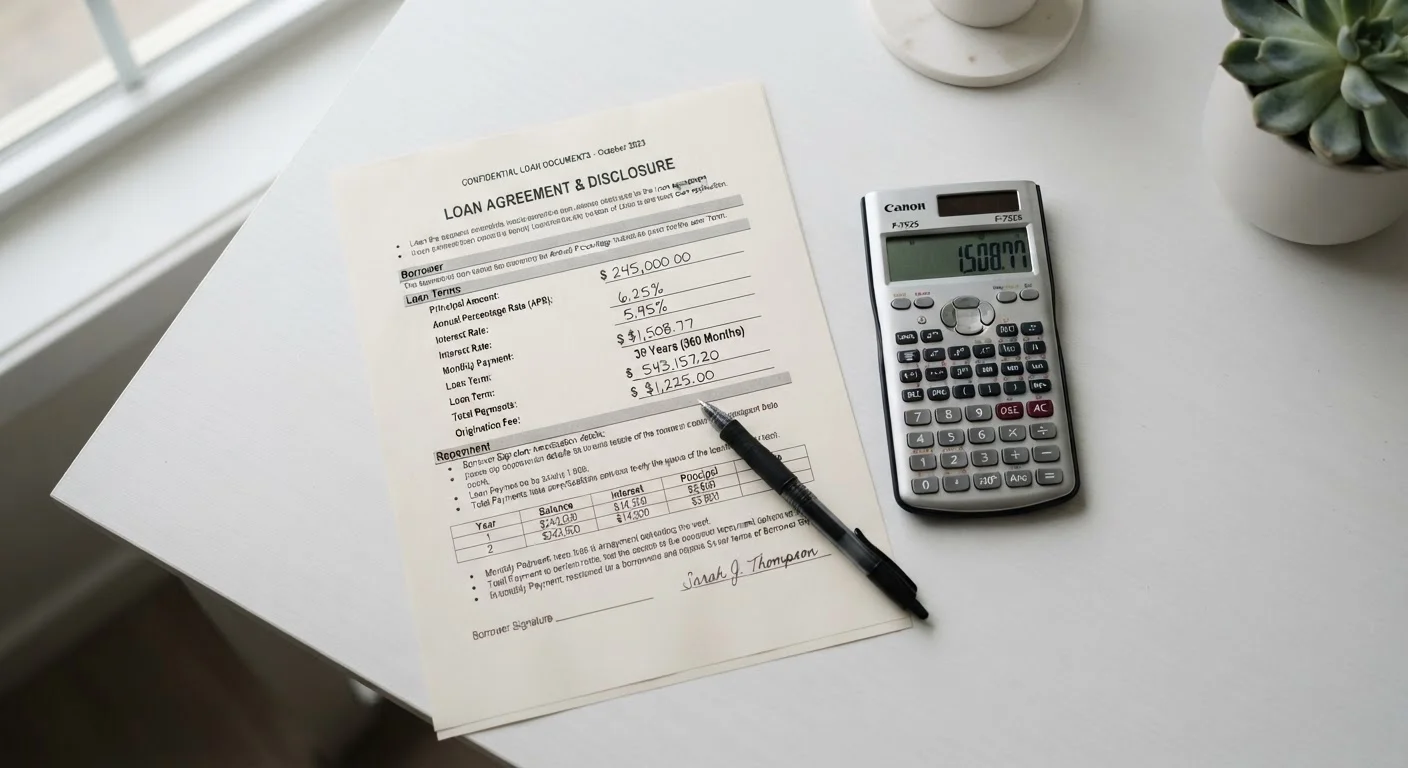
Photo: MoneyOnMind.net | Navigate Money With Clarity editorial
Key Takeaways
- The interest rate and APR are different - APR includes fees and gives a truer picture of cost.
- Compounding frequency affects how quickly interest accumulates on your balance.
- Origination fees, prepayment penalties, and late charges can significantly increase total loan cost.
- A longer repayment term lowers monthly payments but increases total interest paid.
- Always compare APRs - not just rates - when evaluating loan offers.
Principal, Interest, and the Starting Point of Every Loan
Every loan starts with a principal - the amount you actually borrow. Interest is the lender's fee for providing that money, calculated as a percentage of the outstanding balance. But the relationship between the two is rarely as simple as it first appears.
Most consumer loans in the U.S. use amortization, meaning each fixed monthly payment covers both interest and a slice of the principal. In the early months, the bulk of your payment goes toward interest; over time, more of it chips away at the principal. This is why paying off a loan early can save a meaningful amount - you eliminate future interest charges on the remaining balance.
To understand how much a loan will truly cost, you need to look beyond the principal and the quoted interest rate. See our glossary of essential loan terms for plain-language definitions of these and other key concepts.
Interest Rate vs. APR: Why the Distinction Matters
Lenders advertise a nominal interest rate, but the number that tells the full story is the Annual Percentage Rate (APR). The APR wraps in most mandatory fees - origination charges, broker fees, certain closing costs - and expresses the total annualized cost of credit as a single percentage.
For example, a personal loan advertised at 9% interest could carry an APR of 11% once a 2% origination fee is factored in. Over a three-year term, that gap compounds into real dollars.
~$1,500
Average origination fee on personal loans
Based on Consumer Financial Protection Bureau data, origination fees on personal loans commonly range from 1% to 8% of the loan amount, adding meaningfully to total borrowing cost.
29.99%
Typical maximum credit card APR
Many variable-rate credit cards carry APRs that can reach or exceed this level, illustrating how revolving credit can be among the most expensive borrowing forms available to consumers.
When comparing loan offers, always line up APRs against each other, not just the quoted rates. A lower rate with heavy fees can easily be more expensive than a slightly higher rate with no fees.
How Compounding Schedules Affect Your Balance
Interest doesn't always accrue at the same pace. The compounding schedule determines how often interest is calculated on your outstanding balance. Common schedules include daily, monthly, and annually.
With daily compounding, interest accrues every single day on whatever balance you carry. A loan with 12% nominal annual interest compounded daily is effectively more expensive than the same rate compounded monthly, because each day's interest is added to the base for the next calculation. For most installment loans, this difference is modest - but for revolving credit like credit cards, where balances often carry over, daily compounding can accelerate debt growth noticeably.
If you want to understand a scenario where this becomes especially significant, interest capitalisation - where unpaid interest is added to your principal - can cause balances to grow even when you're making regular payments.
Check Your Compounding Frequency Before You Sign
Hidden Charges: Fees That Add to the Real Cost
Interest is only one component of borrowing cost. Fees can quietly inflate what you owe:
- Origination fee: A one-time charge - often 1%-8% of the loan amount - deducted upfront or rolled into the balance. It reduces the cash you actually receive while increasing what you repay.
- Prepayment penalty: Some lenders charge a fee if you pay off the loan early, since early payoff cuts into their projected interest income.
- Late payment fee: A fixed charge or percentage applied when a payment misses its due date. Repeated late payments also damage your credit score.
- Returned payment fee: Triggered when a payment bounces due to insufficient funds.
Always read the loan agreement's fee schedule before signing. Lenders are legally required to disclose these under federal law, but the details are often buried in fine print.
Federal Disclosure Requirements Protect Borrowers
Loan Term, Monthly Payments, and Total Cost Trade-offs
The loan term - the repayment period - shapes both your monthly obligation and your total cost. A longer term spreads payments over more months, making each installment smaller, but you pay interest for longer, which raises the total amount repaid.
Consider a $15,000 personal loan at a fixed 10% APR. A 3-year term produces higher monthly payments but lower total interest. Stretching that to 5 years reduces the monthly payment noticeably, but the total interest paid over the life of the loan increases substantially. Neither option is automatically right - the decision depends on your cash flow and how much total cost you're willing to accept.
For a full walkthrough of how loan structures work in practice, our first-timer's loan roadmap walks through each stage from application to final payment. And once you've borrowed, exploring debt repayment strategies can help you minimize the total interest you pay over time.
This article is for general informational and educational purposes only and does not constitute personalized financial, legal, or tax advice. Loan terms, fees, and regulations vary by lender and by state. Consult a licensed financial professional before making borrowing decisions specific to your situation.
Frequently Asked Questions
The content on this site is for informational purposes only and is not a substitute for professional advice. Always consult a qualified professional for guidance specific to your situation.