
Hard Inquiries vs. Soft Inquiries on Your Credit Report

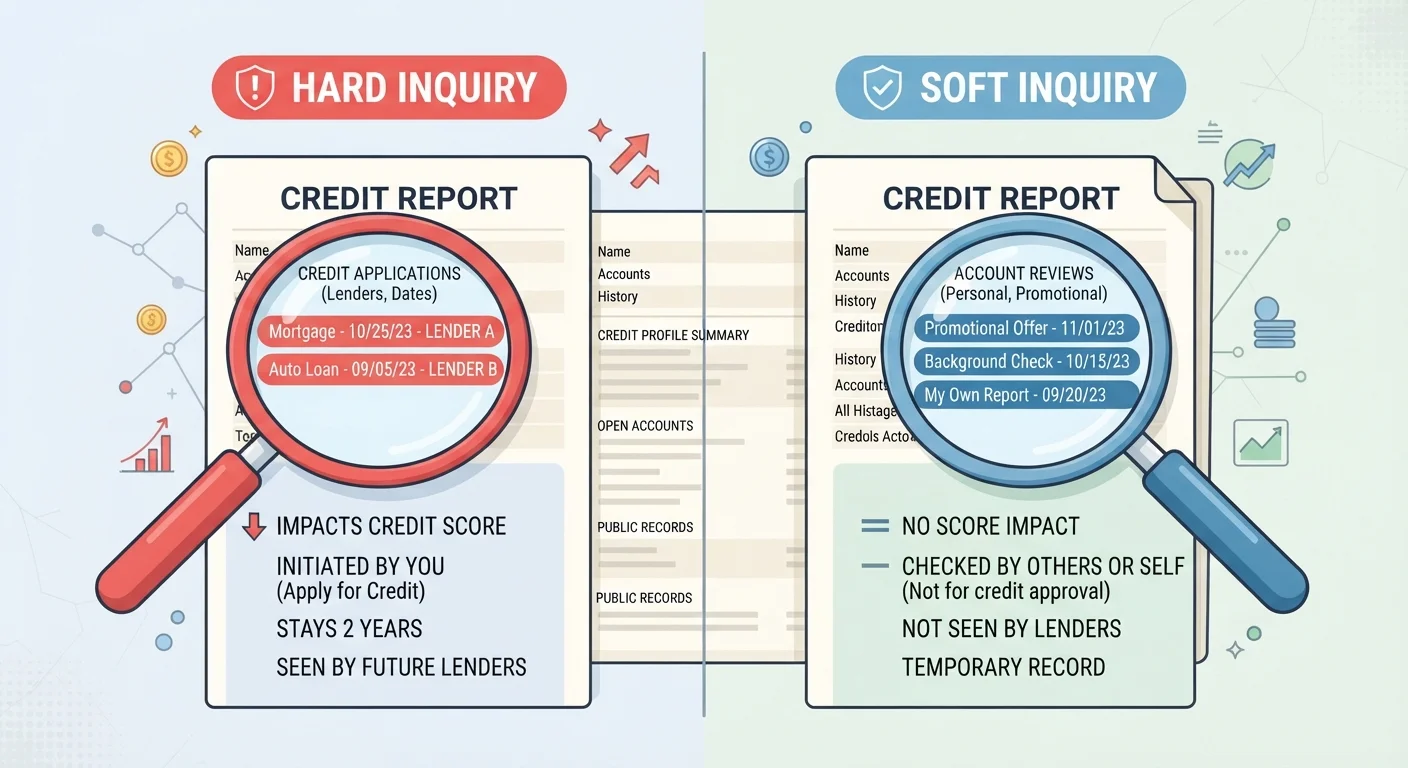
Photo: MoneyOnMind.net | Navigate Money With Clarity editorial
Key Takeaways
- Hard inquiries occur when you apply for credit and can temporarily lower your score by a few points.
- Soft inquiries - like checking your own report - never affect your credit score at all.
- Hard inquiries stay on your credit report for two years but typically influence scoring for only twelve months.
- Multiple hard inquiries for the same loan type within a short window are often counted as a single inquiry by scoring models.
- You can check your own credit report without triggering a hard inquiry or harming your score.
What Makes an Inquiry Hard or Soft?
Every time someone accesses your credit file, that access is recorded as an inquiry. However, not all inquiries are created equal. The critical distinction comes down to one factor: whether you actively applied for new credit.
A hard inquiry (also called a hard pull) is triggered when a lender or creditor reviews your credit report because you have submitted a formal application - for a credit card, personal loan, auto loan, mortgage, or similar product. Because you initiated the request for credit, this type of inquiry can temporarily affect your credit score.
A soft inquiry (also called a soft pull) happens in situations where no formal credit application is involved. Common examples include checking your own credit report, an employer running a background check, or a credit card issuer pre-screening you for a promotional offer. Soft inquiries are recorded on your report but are never factored into your credit score calculation.
Understanding this split is foundational. For a deeper look at how your credit file and score relate to each other, see Credit Report vs. Credit Score: Two Different Things That Work Together.
Side-by-Side: Hard vs. Soft Inquiries
The table below breaks down the key differences so you can quickly identify which type of inquiry applies to any situation you encounter.
| Criterion | Hard Inquiry | Soft Inquiry |
|---|---|---|
| Triggered by | Formal credit application | Personal checks, pre-screens, employer checks |
| Affects credit score? | Yes, temporarily | No, never |
| Stays on report | 2 years | Listed, but only visible to you |
| Scored by lenders | Yes - visible to other creditors | No - not visible to other creditors |
| Typical point impact | Fewer than 5 points (usually) | Zero points |
| Common examples | Credit card, mortgage, auto loan applications | Checking your own report, pre-approval offers |
One important nuance: hard inquiries are visible to lenders who pull your report, while soft inquiries are generally only visible to you when you access your own file. This means a potential creditor reviewing your report will not see the soft-pull checks from your own monitoring activity.
How Much Do Hard Inquiries Actually Hurt Your Score?
The short answer: less than most people fear, but the impact is real. A single hard inquiry typically lowers a FICO Score by fewer than five points, according to FICO's published guidance. The effect is usually temporary, fading within a few months as long as your other credit behaviors remain positive.
<5 pts
Typical score drop from one hard inquiry
FICO's published guidance indicates a single hard inquiry generally lowers a score by fewer than five points for most consumers.
12 months
Period hard inquiries influence FICO scoring
Though hard inquiries appear on your report for two years, FICO Score models stop factoring them into your score after approximately twelve months.
14-45 days
Rate-shopping window for grouped inquiries
FICO and VantageScore models consolidate multiple loan inquiries of the same type made within this window into a single scoring event.
Hard inquiries remain on your credit report for two years. However, FICO's scoring models only factor them into your score for the first twelve months. VantageScore models may handle the timeline slightly differently, which is one reason you may see minor variation across the scores different lenders use.
The more significant concern arises when multiple hard inquiries appear in a short period across different credit types - for example, applying for a car loan, a credit card, and a personal loan all within the same month. This pattern can signal financial stress to lenders. By contrast, if you are rate-shopping for a single loan type (like a mortgage), scoring models are designed to treat several inquiries within a defined window - typically 14 to 45 days depending on the model - as one inquiry. This protects consumers who are comparing offers responsibly.
To understand exactly what lenders see when they review your file, including how inquiries appear in context, visit What Lenders Actually See When They Pull Your Credit Report.
Checking Your Own Credit: Always a Soft Inquiry
One of the most persistent credit myths is that checking your own credit report will hurt your score. It will not. Accessing your own report - whether through AnnualCreditReport.com or a credit monitoring service - is always classified as a soft inquiry and has no effect on your credit score whatsoever.
In fact, regularly reviewing your own report is a sound financial practice. It allows you to catch errors, spot unfamiliar hard inquiries (which can be an early sign of identity theft), and understand what lenders will see when they evaluate you. For step-by-step guidance on accessing your file safely and for free, see How to Pull Your Credit Report Without Hurting Your Score.
Pre-Approval Offers Are Always Soft Inquiries
This article provides general financial education and is not personalized financial or credit advice. Credit scoring models and lender practices vary. For guidance specific to your situation, consult a qualified financial adviser or credit counselor.
The content on this site is for informational purposes only and is not a substitute for professional advice. Always consult a qualified professional for guidance specific to your situation.