
The Anatomy of a Debt Spiral: Why Small Balances Become Big Problems

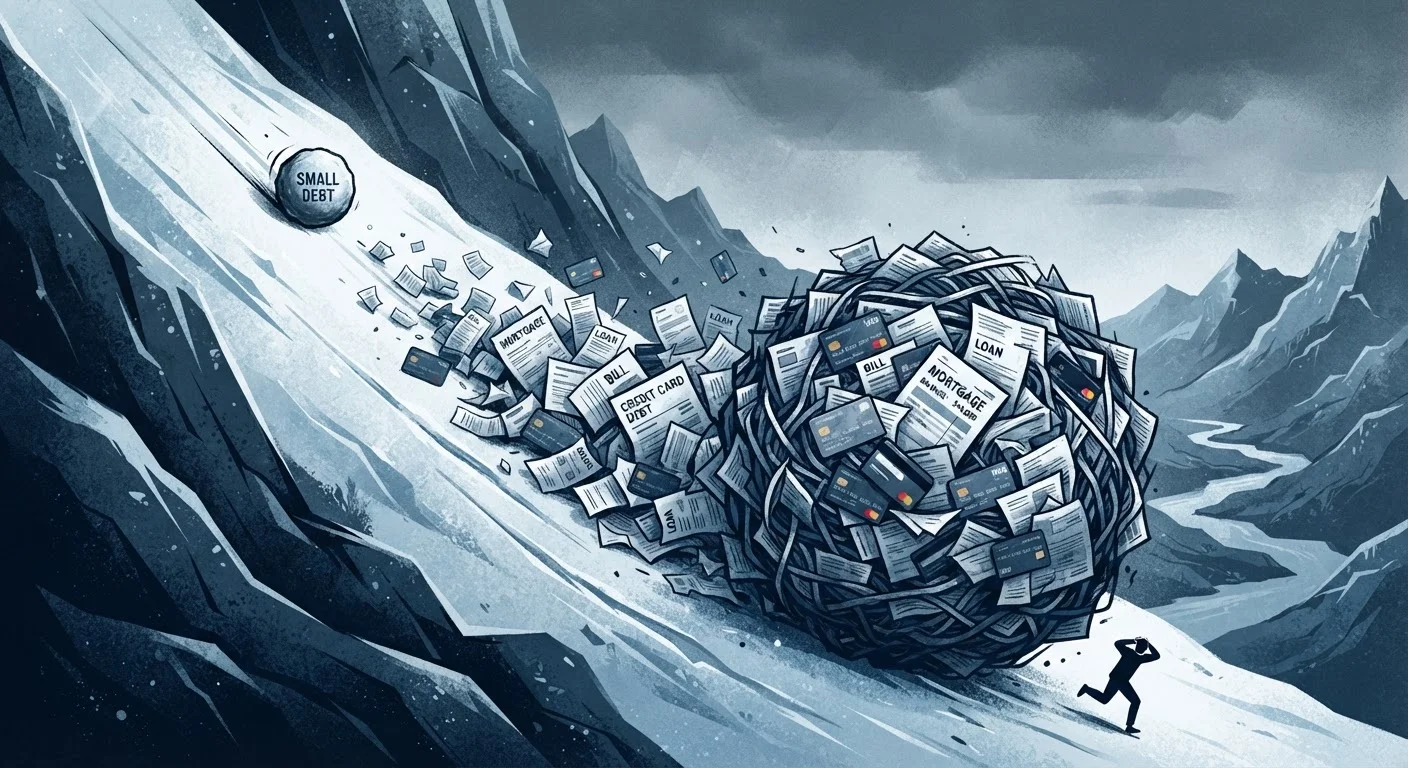
Photo: MoneyOnMind.net | Navigate Money With Clarity editorial
Key Takeaways
- Minimum payments are designed to keep balances alive longer, maximizing interest paid over time.
- High APRs combined with fees can cause a balance to grow even when you make regular payments.
- Missing a single payment can trigger penalty rates that dramatically accelerate the spiral.
- Breaking the cycle requires paying more than the minimum - even small additional amounts matter.
- Understanding how interest compounds is the first step to stopping a spiral before it starts.
How a Small Balance Starts Growing on Its Own
Most debt spirals don't start with a financial catastrophe. They start with a $400 car repair charged to a credit card, a medical bill deferred to next month, or a student loan payment reduced to keep cash flow alive. What turns a manageable balance into a crisis is not the original amount - it's what happens to it when left to compound.
Credit card APRs in the US commonly range from 20% to 29% or higher. At 24% APR, a $1,000 balance accrues roughly $20 in interest in a single month. If the minimum payment due is $25, only $5 actually reduces the principal. The following month, interest is calculated on $995 - and so the cycle continues, almost imperceptibly at first.
10+ years
Time to repay $3,000 at 22% APR with minimum payments
Consumer finance calculations show that minimum-only payments on moderate balances can extend repayment timelines far beyond what most borrowers expect.
~29%
Common penalty APR on US credit cards
Many US credit card agreements allow lenders to apply a penalty interest rate following a late or returned payment, substantially increasing monthly finance charges.
$41
Maximum late fee permitted under federal rules (as of recent CFPB guidelines)
The Consumer Financial Protection Bureau has regulated late fee caps for large credit card issuers; amounts may vary by issuer type and account terms.
This is the compounding trap: interest charges accumulate on top of existing interest, meaning the debt grows even when you're making consistent payments. Many borrowers don't notice the problem until the balance is noticeably larger than when they started paying.
The Role of Fees and Penalty Rates
Interest alone doesn't always drive the spiral - fees and triggered rate increases often accelerate it dramatically. A single late payment can result in a late fee (commonly up to $30-$41 under federal guidelines) and trigger a penalty APR that may exceed 29%. Once a penalty rate is applied, the monthly interest charge on even a modest balance can dwarf the minimum payment.
Penalty Rates Are Not Always Permanent
Returned payment fees, over-limit fees, and annual fees compound the pressure further. Each additional charge increases the principal, and a higher principal means more interest next month. Borrowers caught in this loop often find themselves paying consistently yet watching their balance stubbornly refuse to fall - or actively rise.
This is also where income shocks become dangerous. A reduced paycheck or unexpected expense forces the borrower to choose between the debt payment and essential needs. Skipping even one payment resets the penalty clock and can cause months of progress to evaporate. For a deeper look at how repayment decisions interact with real financial constraints, see navigating debt on a tight budget.
Why Minimum Payments Are Structured the Way They Are
Minimum payment formulas are set by lenders, not by neutral financial logic. They are typically calculated as a percentage of the outstanding balance - often between 1% and 3% - or a flat dollar floor, whichever is greater. This structure keeps accounts current (avoiding default) while extending the repayment timeline as long as possible.
The result: a $3,000 balance at 22% APR, paying only the minimum each month, can take more than 10 years to fully repay and cost over $2,000 in total interest - more than half the original balance paid purely in finance charges. Many borrowers don't realize this because statements rarely frame it that way. The common beliefs about debt repayment that cost you money - including the idea that making the minimum payment keeps you on track - are worth examining critically.
Pay Even $10 More Than the Minimum
Breaking the Cycle: What Actually Works
Escaping a debt spiral requires interrupting the compounding process - which means paying down principal faster than interest accumulates. Even modest overpayments above the minimum redirect money toward the balance itself, shrinking the base on which future interest is calculated.
Structured repayment strategies - such as targeting the highest-interest balance first (sometimes called the avalanche method) - are designed specifically to reduce the total interest paid across multiple debts. Debt consolidation, which combines multiple high-rate balances into a single lower-rate loan, can also slow the spiral if the new terms genuinely reduce the effective interest rate. These approaches are explored further in the debt management hub.
It's equally important to recognize behavioral patterns that undo progress. Paying down a card and then gradually reloading it is one of the most common ways people re-enter a spiral. The habits that lead borrowers back into debt are worth understanding before assuming the problem is solved. For a broader set of repayment strategies, the debt repayment hub provides additional frameworks.
This article is for general informational and educational purposes only and does not constitute personalized financial, legal, or tax advice. Individual debt situations vary significantly. Consult a licensed financial professional or nonprofit credit counselor before making decisions about your specific debt obligations.
Frequently Asked Questions
The content on this site is for informational purposes only and is not a substitute for professional advice. Always consult a qualified professional for guidance specific to your situation.