
Goal Setting

Balancing Debt Repayment With Forward-Looking Financial Goals

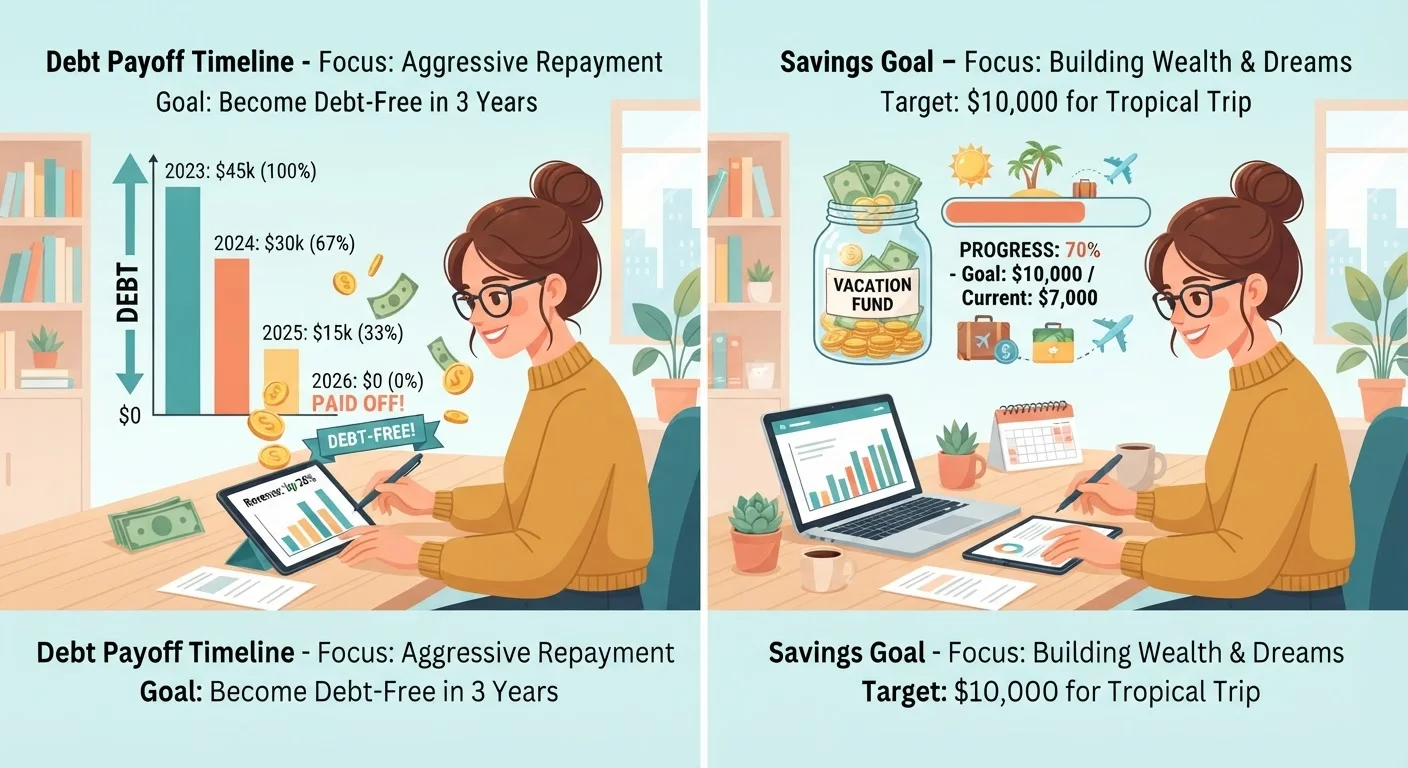
Balancing Debt Repayment With Forward-Looking Financial Goals

Photo: MoneyOnMind.net | Navigate Money With Clarity editorial

Carrying loans doesn't have to mean postponing all financial goals. Understand how to structure progress on both fronts at the same time.

Key Takeaways

  • You don't have to fully eliminate debt before starting to work toward other financial goals.
  • Interest rate comparisons help you decide whether to prioritize debt repayment or savings contributions.
  • Small, consistent progress on multiple fronts outperforms an all-or-nothing approach over time.
  • SMART financial milestones turn vague ambitions into measurable, trackable steps alongside debt repayment.
  • An emergency fund is a non-negotiable foundation — even while carrying debt.

The False Choice Between Debt and Your Future

Many young professionals operate under a deeply ingrained belief: pay off every dollar of debt first, then start living toward your other goals. This all-or-nothing thinking is understandable — debt feels like a drain that should be eliminated before anything else gets attention. But for most people carrying student loans, car financing, or credit card balances, it leads to years of deferred progress on savings, retirement contributions, and meaningful life milestones.

The better framing is a parallel strategy: structure your finances so that debt repayment and forward-looking goals move simultaneously, even if at different speeds. This isn't about splitting focus carelessly — it's about allocating resources intelligently based on interest rates, goal timelines, and your current financial baseline. For a deeper grounding in debt mechanics before building your parallel plan, see our complete guide to managing debt for young professionals.

Best Practices for Balancing Both at Once

The following practices are drawn from established personal finance frameworks. They're designed to be applied together, not cherry-picked. Start by auditing your current situation — what you owe, to whom, at what rate — then layer in these approaches.

1

Build a minimum emergency fund before aggressively paying down debt

Without liquid reserves, any unexpected expense — a medical bill, a car repair — forces you back into higher-cost debt, erasing repayment progress. A small buffer of $1,000–$2,000 acts as a circuit breaker that protects your plan. This is a priority even when carrying interest-bearing debt.
Example: A professional with $18,000 in student loans pauses extra payments for two months to accumulate a $1,500 emergency fund, then resumes accelerated repayment — protected against setbacks.
2

Compare your debt interest rate to the expected return on your financial goal

This comparison is the central decision rule for prioritization. If your debt carries a 7% interest rate and your employer matches 401(k) contributions at 100%, capturing that match generates an immediate return higher than the debt cost. If debt interest exceeds realistic savings growth, concentrate repayment first. For a detailed breakdown, see when to prioritize debt over saving — and when not to.
Example: A borrower with a 5% student loan always contributes enough to capture their full employer 401(k) match before making extra loan payments — because the match is an instant 100% return.
3

Assign every dollar a job using a structured allocation framework

A budget like the 50/30/20 rule — 50% to needs, 30% to wants, 20% to savings and debt — gives you permission to pursue multiple goals without guilt or confusion. Adjusting the 20% bucket to split between debt overpayments and goal-directed savings creates a workable dual-track system. See how paying off debt while saving can work simultaneously.
Example: After covering essentials, a professional allocates $300/month to extra student loan payments and $200/month to a house deposit fund — both advancing, neither starved.
4

Use lump sums and windfalls strategically rather than spending them by default

Tax refunds, bonuses, and freelance income represent rare opportunities to make asymmetric progress on debt or savings goals without affecting your monthly budget. Directing even half of a windfall to high-interest debt can meaningfully shorten your repayment timeline and reduce total interest paid.
Example: A professional receiving a $2,400 tax refund sends $1,500 to their highest-rate credit card and deposits $900 into their travel savings account — advancing both goals in one move. Explore how lump sums reduce interest and shorten repayment.
5

Review and rebalance your allocation every six months

Income changes, debt balances shrink, and goals evolve. A plan that was optimal at 25 may be misallocated at 27 if you've paid off a loan or received a raise. Scheduled reviews ensure your money keeps working at the right priority as your situation shifts.
Example: After paying off a car loan, a professional redirects that freed-up $280/month — splitting it between increasing emergency fund contributions and a Roth IRA — rather than absorbing it into general spending.

This article provides general financial education and is not personalised financial advice. Consult a qualified financial adviser or planner before making decisions specific to your circumstances.

Quick Actions You Can Take This Week

Strategy only works when it becomes behavior. These are specific, low-friction actions you can take immediately to start building momentum on both debt repayment and your forward-looking goals.

high List every debt you carry with its interest rate and minimum payment, then identify the highest-rate balance — that's your primary repayment target.
high Check whether your employer offers a retirement contribution match and, if so, confirm you're contributing at least enough to capture it fully.
medium Open a separate savings account labeled with a specific goal (e.g., "Emergency Fund" or "Home Deposit") and set up an automatic monthly transfer, even if it starts at $25.
medium Schedule a 30-minute calendar block this month to calculate your debt-free date based on your current payment — then model what an extra $50/month would do to that date.

For a structured approach to organizing all your debt obligations in one place, explore strategies for managing multiple loans at once — particularly useful if you're juggling student loans, car financing, and a credit card simultaneously.

Making It Measurable: Turning Goals Into Milestones

Vague ambitions — "save more," "pay off my loans someday" — don't generate traction. What works is converting both debt repayment targets and savings goals into SMART milestones: Specific, Measurable, Achievable, Relevant, and Time-bound.

For example: instead of "save for a house," try "save $12,000 toward a down payment by directing $500 per month into a dedicated account over 24 months." That's a concrete, schedulable commitment that can coexist with a student loan repayment plan.

“A goal without a plan is just a wish. The discipline of writing down a specific goal with a date creates the psychological contract that makes follow-through far more likely.”

— Brian Tracy, Author and speaker on personal development and goal achievement

Use the same logic for debt. Rather than "pay off my credit card," define it as "eliminate the $4,200 balance on my card within 18 months by paying $250 above the minimum each month." Knowing the endpoint makes the trade-offs visible — and manageable. Learn how to build a debt repayment plan you can actually stick to using this same milestone approach.

On Flexibility and Adjustments

No financial plan survives contact with real life perfectly intact. Job changes, health events, and shifting priorities will require you to adjust your allocations. That's not failure — that's how sound financial planning actually works. Build a plan robust enough to adapt, not so rigid it breaks under pressure.

Financial Planning Editorial Team

MoneyOnMind.net | Navigate Money With Clarity

Financial Planning Editorial Team is the collective byline for our editorial team and contributor network. Articles published under this byline or an editorial pen name are researched, written, and reviewed according to our editorial standards for clarity, consistency, and independence before publication.

Budgeting BasicsGoal SettingDebt Management
View author profile

The content on this site is for informational purposes only and is not a substitute for professional advice. Always consult a qualified professional for guidance specific to your situation.