
Institutional, Federal, and Private Scholarships: Navigating the Three Main Sources

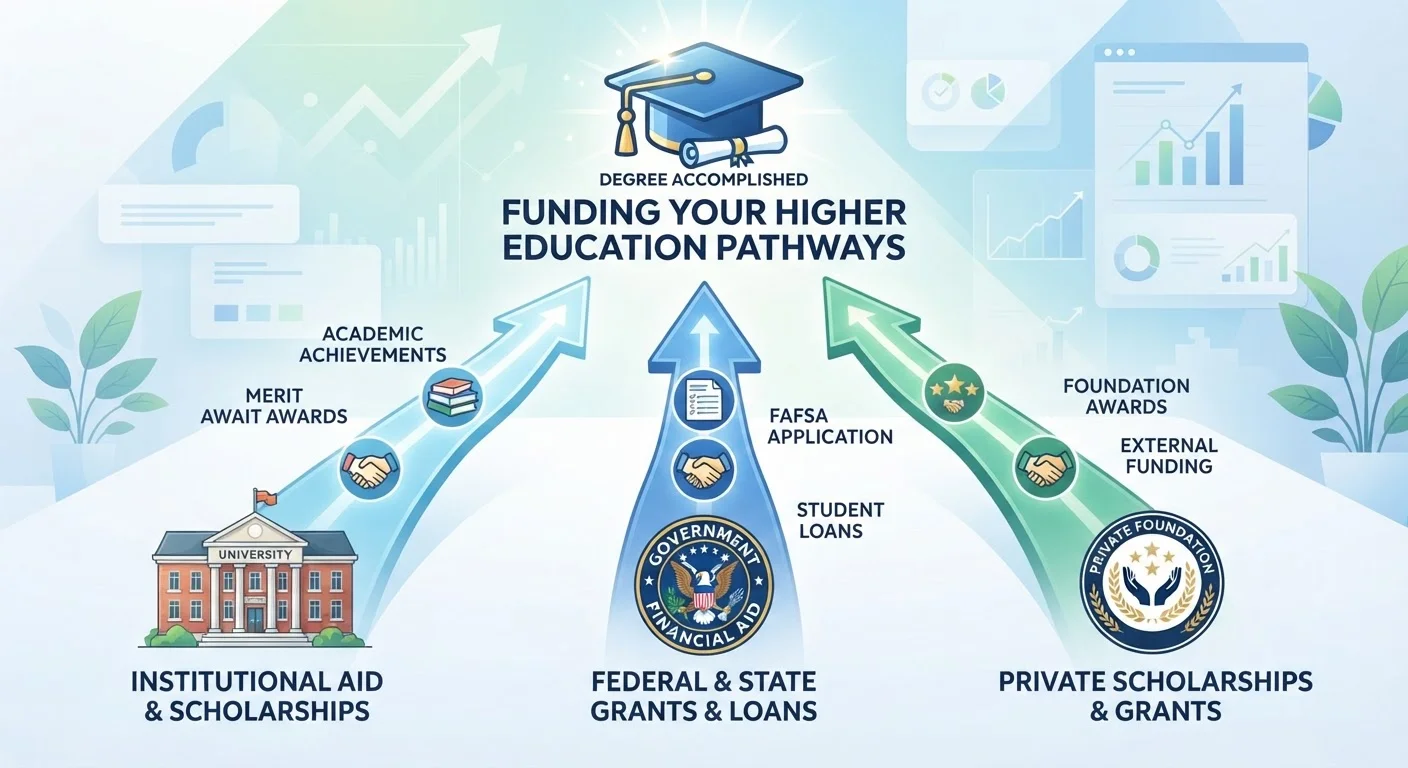
Photo: MoneyOnMind.net | Navigate Money With Clarity editorial
Key Takeaways
- Institutional scholarships come directly from colleges and are often the largest single source of aid for enrolled students.
- Federal scholarship programs are limited but highly reliable; most federal education money comes through grants and loans instead.
- Private scholarships from foundations, nonprofits, and employers can supplement institutional aid and sometimes fill gaps loans would otherwise cover.
- Each source has distinct eligibility criteria, application timelines, and renewal conditions - treating them as one system leads to missed opportunities.
- Stacking awards from multiple sources is often possible and encouraged, but some schools impose outside scholarship limits on need-based packages.
Why the Source of a Scholarship Matters
When most people think about scholarships, they picture a single pool of money competed for through essays and GPAs. In reality, scholarships flow from three structurally different systems - each with its own eligibility rules, application process, and funding logic. Knowing which system you're dealing with changes everything: when you apply, what documents you need, and how the award interacts with the rest of your financial aid package.
This article compares institutional, federal, and private scholarships side by side so you can approach each source with a clear plan. For a broader overview of how these fit into the full aid landscape, see The Scholarship Landscape for Young Americans.
| Institutional | Federal | Private | |
|---|---|---|---|
| Who awards it | Your college or university | Federal government agency | Foundations, nonprofits, employers |
| Typical award size | Hundreds to full tuition | Up to $4,000/yr (TEACH) | Hundreds to six figures |
| Need vs. merit basis | Both, varies by school | Need or service obligation | Extremely varied by program |
| Application timing | Admission cycle (Oct-Jan) | Tied to FAFSA or program deadline | Year-round, rolling deadlines |
| Renewal likelihood | Often renewable with GPA minimum | Annual reapplication required | Usually one-time awards |
| Competition level | Moderate (school applicant pool) | Low volume, highly specific | Varies widely by award |
| Best suited for | Enrolled or admitted students | STEM, teaching service-goers | Niche backgrounds, any stage |
Institutional Scholarships: Your College as a Funding Source
Institutional scholarships are awarded directly by colleges and universities, funded either from endowments, operating budgets, or donor-designated funds. They are typically the largest single source of non-repayable education funding available to enrolled students - merit scholarships at selective private universities can reach full tuition or beyond.
These awards are usually tied to your admission application. Many schools automatically consider all admitted students; others require a separate scholarship application or audition portfolio. Eligibility criteria vary widely: some are purely merit-based (GPA, test scores, class rank), others need-based, and many blend both. To understand how that distinction affects you personally, see Merit vs. Need-Based Scholarships.
Key practical points:
- Timing: Deadlines often align with early decision or early action cycles - typically October through January for fall enrollment.
- Renewal: Most institutional awards are renewable, but require maintaining a minimum GPA or credit load. Review conditions carefully before accepting.
- Interaction with other aid: Schools may reduce need-based institutional aid when you receive outside scholarships - ask your financial aid office how they handle this before applying elsewhere.
Negotiate Your Institutional Award
Federal Scholarship Programs: Reliable but Narrow
The federal government is the largest single source of education funding in the US, but most of that money flows through grants (like the Pell Grant) and loans - not scholarships in the traditional sense. True federal scholarship programs exist but are targeted and limited in scope.
The most prominent federal scholarship-adjacent programs include:
- TEACH Grant: Up to $4,000 per year for students completing a teacher preparation program, with a service obligation to teach in a high-need school for four years. Failure to complete the service converts the grant to an unsubsidized loan.
- Barry Goldwater Scholarship: Competitive award for STEM undergraduates, administered federally through the Goldwater Foundation.
- NSF Graduate Research Fellowship: For graduate students in STEM fields; provides a stipend and tuition coverage for three years.
Because federal scholarship options are narrow, most students rely on federal grants to fill the need-based portion of their aid. The Grants & Free Aid hub covers those options in detail. For how federal and institutional aid interact within a single package, see Federal vs. Institutional Aid: Two Systems, One Package.
Private Scholarships: The Most Varied - and Most Accessible - Source
Private scholarships come from foundations, nonprofits, community organizations, professional associations, and employers. This category is extraordinarily diverse: awards range from a few hundred dollars from a local community foundation to six-figure fellowships from major national organizations. Because eligibility criteria are set by each organization independently, private scholarships often reach students who may not qualify for large institutional awards.
Common private scholarship categories include:
- Field-of-study awards: Funded by professional associations (nursing, engineering, law) targeting students in specific majors.
- Identity and community awards: Based on heritage, religious affiliation, geographic origin, or first-generation status.
- Employer-sponsored scholarships: Some large employers offer scholarships to employees' dependents or to employees returning to school - often underutilized.
- Essay and competition-based awards: Open to broad applicant pools; strong writing is the primary differentiator.
Private scholarships are also often the most accessible for working adults and career changers. If that describes you, explore scholarships for working adults and career changers for options tailored to non-traditional students.
Watch for 'Scholarship Displacement'
When layering private scholarships with institutional aid, your overall funding strategy matters. See Stacking Scholarships for guidance on combining multiple awards without triggering aid reductions.
Building Your Multi-Source Scholarship Strategy
Treating these three sources as separate tracks - each with its own calendar, documents, and criteria - is the foundation of an effective strategy. Start with your institution (deadlines often come first), then determine which federal programs you qualify for, and build a rolling private scholarship calendar across the full academic year.
For a structured approach to identifying awards you're genuinely eligible for without wasting time on low-probability applications, see Building a Scholarship Search Strategy That Actually Produces Results. And when you're ready to submit, The Scholarship Application Process, Explained walks through every stage from search to submission.
One caution: the private scholarship space includes fraudulent schemes. Before investing time in any application, review the warning signs outlined in Scholarship Scams and Legitimate Opportunities.
This article is for general informational purposes only and does not constitute personalized financial or legal advice. Scholarship eligibility, award amounts, and renewal conditions vary by program and institution. Consult your financial aid office or a qualified adviser for guidance specific to your circumstances.
The content on this site is for informational purposes only and is not a substitute for professional advice. Always consult a qualified professional for guidance specific to your situation.