
Monthly Maintenance Fees: What Triggers Them and What Doesn't

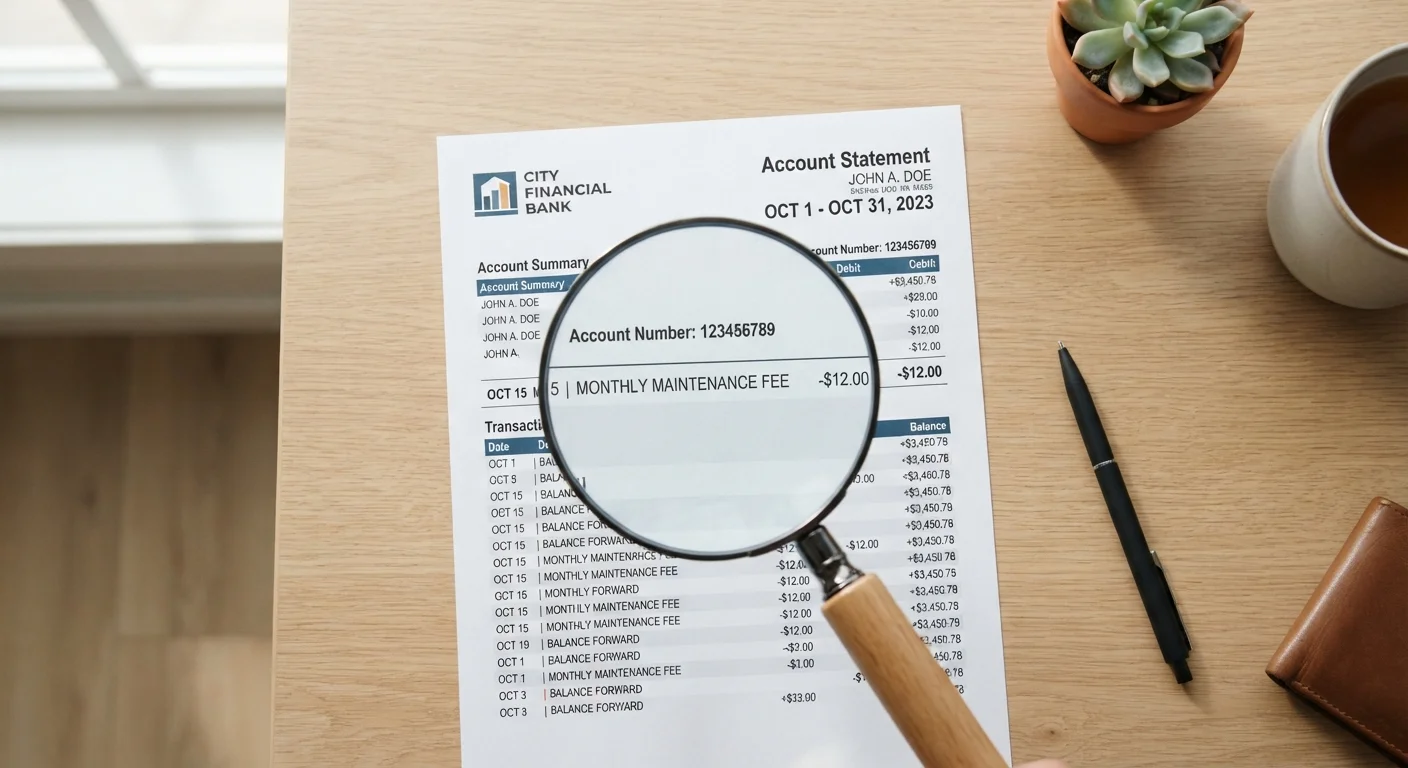
Photo: MoneyOnMind.net | Navigate Money With Clarity editorial
Key Takeaways
- Monthly maintenance fees typically range from $5 to $25 per month depending on the account type.
- Most banks will waive the fee if you meet one or more qualifying conditions each statement cycle.
- Common waiver conditions include maintaining a minimum daily balance or setting up direct deposit.
- Failing to meet even one condition in a given month usually results in the full fee being charged.
- Reviewing your account's fee schedule - not just its marketing page - reveals the actual waiver rules.
How Monthly Maintenance Fees Work
Monthly maintenance fees are not random - they follow a clearly defined set of rules established when you open an account. The bank evaluates your account activity at the close of each statement cycle and applies the fee only if you failed to meet at least one waiver condition. If you met the condition, the fee is suppressed automatically. If you did not, the charge posts without any warning.
This system matters because the fee is not a penalty for doing something wrong - it is simply the default state for accounts that fall below the bank's preferred activity thresholds. Understanding this framing shifts how you approach the account: the goal is not to avoid a punishment, but to consistently meet a qualifier.
Patterns that quietly drain bank balances often start with maintenance fees that go unnoticed for months, making this one of the most important fee types to understand early.
$5-$25
Typical monthly maintenance fee range
Bankrate and FDIC consumer resources consistently document this range for standard checking accounts at traditional U.S. banks.
$144-$300
Annual cost if fee is never waived
At common fee levels, an account charged the full monthly fee every month costs hundreds of dollars per year in avoidable charges.
$1,500
Common minimum daily balance threshold
Many major U.S. banks set the minimum daily balance waiver threshold at or near $1,500 for standard checking accounts.
What Triggers the Fee
The fee is triggered by the absence of qualifying activity - not by any specific action you take. The most common triggers are:
- Balance falling below the minimum: If your account requires a $1,500 minimum daily balance and your balance drops to $1,499 even for one day, the fee typically applies for that entire month.
- No qualifying direct deposit: If your waiver depends on receiving a direct deposit and your payroll is delayed, deposited to a different account, or does not meet the bank's definition of "qualifying," the fee is triggered.
- No debit card activity: Some accounts require a minimum number of debit transactions per month. Missing that threshold - even by one transaction - activates the fee.
- Account type mismatch: Promotional fee waivers tied to linked accounts (like a premium savings or mortgage) lapse when those accounts are closed or transferred.
The common thread is that triggers are binary: you either met the condition or you did not. There is generally no partial credit.
Set a Balance Alert to Stay Above the Threshold
What Does Not Trigger the Fee
Several account behaviors that might seem risky actually have no effect on the maintenance fee calculation:
- Number of withdrawals or transfers: Unless specifically listed as a waiver condition, how often you move money in or out does not factor into maintenance fee eligibility.
- Keeping a low average balance (if minimum is daily-balance-based): Paradoxically, an account with a low average balance that never dips below the minimum threshold will not incur the fee.
- Using ATMs frequently: ATM usage does not typically affect maintenance fee status, though it may generate separate ATM fees.
- Overdrafting and repaying quickly: Overdraft events are charged separately and do not alter your maintenance fee waiver status in most standard accounts.
It is also worth knowing that other overlooked bank fees - like paper statement or inactivity charges - operate under entirely different rules and should be reviewed separately.
How to Reliably Qualify for the Waiver
The most durable strategy is to align your existing financial behavior with the account's waiver conditions rather than changing your habits each month. Start by reading the actual fee schedule - not the marketing summary - to identify every available waiver path your account offers.
Most accounts offer multiple qualifying routes, and you only need to satisfy one. Common reliable options include routing your primary paycheck via direct deposit to that account, or maintaining a balance comfortably above the minimum threshold as a permanent buffer. If neither fits your situation, it may be worth exploring whether a no-fee account structure is a better match.
If you find yourself close to the edge of a fee trigger regularly, asking your bank about fee adjustments is a legitimate option that many customers overlook. Banks often have more flexibility than their fee schedules suggest.
This article provides general financial education and is not personalized financial advice. Fee structures, waiver conditions, and account terms vary by institution. Review your account's official fee schedule or speak with a licensed financial professional regarding your specific situation.
Frequently Asked Questions
The content on this site is for informational purposes only and is not a substitute for professional advice. Always consult a qualified professional for guidance specific to your situation.