
Overdraft Fees vs. Non-Sufficient Funds Fees

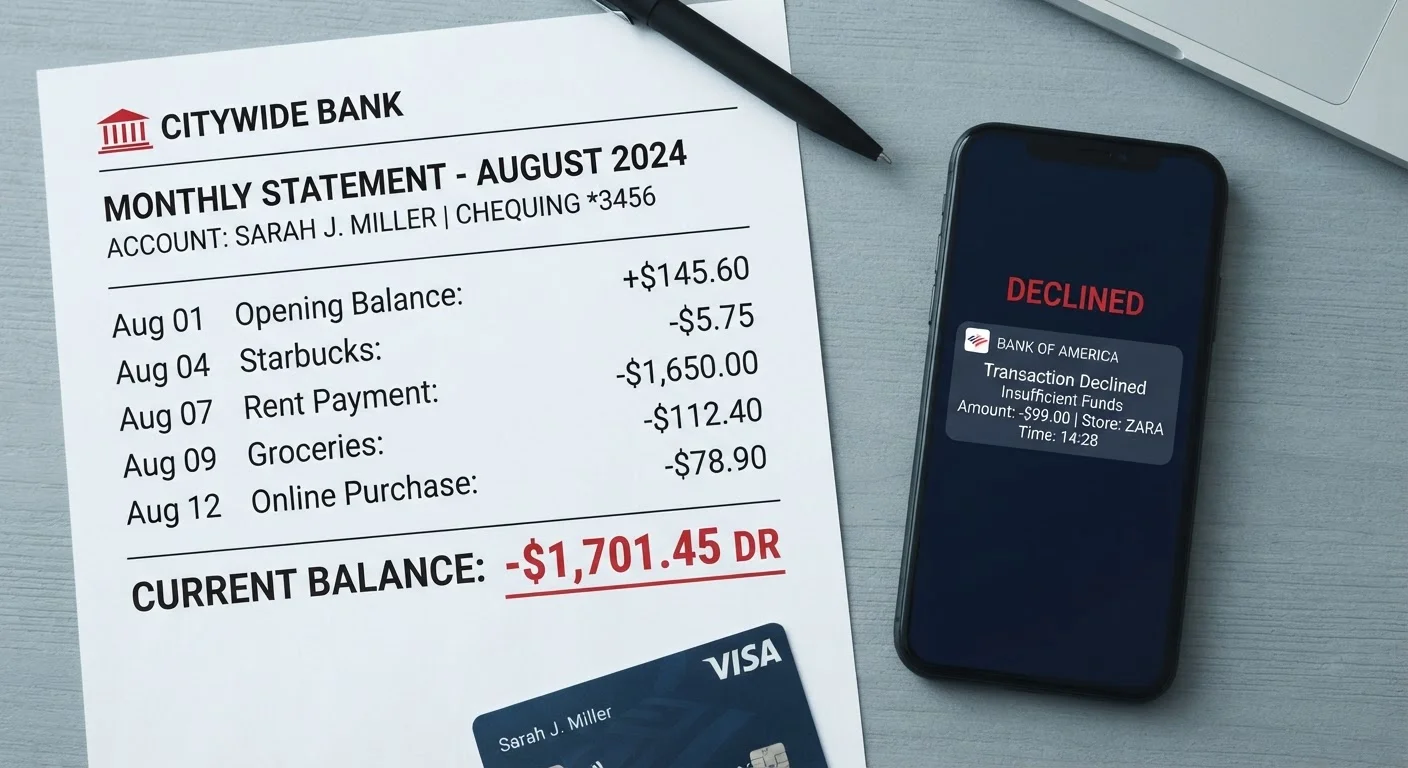
Photo: MoneyOnMind.net | Navigate Money With Clarity editorial
Key Takeaways
- An overdraft fee is charged when your bank pays a transaction your balance can't cover; an NSF fee is charged when the bank refuses it.
- Both fees can reach $25-$35 per incident at many traditional banks, though regulatory pressure has pushed many institutions to reduce or eliminate them.
- NSF fees can trigger cascading consequences: the payee may also charge a returned-payment fee on top of what your bank takes.
- Opting into overdraft coverage for debit transactions is a separate choice from how your bank handles checks and ACH payments.
- Monitoring your balance closely and setting low-balance alerts are the most reliable ways to avoid both fee types.
What Each Fee Actually Means
When your checking account balance falls short of what a transaction demands, one of two things happens: your bank either covers the gap or refuses the payment. Each path has a price tag - and the names attached to those price tags trip up a lot of account holders.
An overdraft fee is charged when your bank decides to honor a transaction even though your balance can't support it. Your account goes negative, the payment clears, and the bank collects a fee for extending that informal short-term cover. Historically, overdraft fees at large U.S. banks have ranged from $25 to $35 per occurrence.
A non-sufficient funds (NSF) fee, sometimes called a returned-item fee, is charged when the bank does the opposite: it declines the transaction and sends the payment back unpaid. The payer's account still gets hit with a fee - often in the same dollar range - even though no money actually moved.
This is the detail most people miss: a declined transaction is not a free transaction. Both outcomes extract money from your account. The only real difference is what happens to the payment itself. For a broader look at the fee patterns that quietly drain checking accounts, it helps to understand both mechanisms together.
Side-by-Side: How They Compare
The table below breaks down the key differences so you can see exactly where the two fees diverge - and where they overlap more than most people expect.
| Criterion | Overdraft Fee | NSF Fee |
|---|---|---|
| Transaction outcome | Payment is completed | Payment is declined/returned |
| Typical fee range (traditional banks) | $25-$35 per occurrence | $25-$35 per occurrence |
| Account balance after | Goes negative | Stays at (or near) zero |
| Risk of secondary fees | Lower - payment cleared | Higher - payee may charge returned-payment fee |
| Common triggers | Debit card purchases, ATM withdrawals | Checks, ACH/automatic payments |
| Opt-in required? | Yes, for debit/ATM (federal rule) | No opt-in required |
| Credit impact | Minimal if resolved promptly | Possible if returned payment causes account closure |
One nuance worth highlighting: NSF fees create a secondary cost risk. When a check or automatic payment is returned, the recipient - a landlord, utility company, or lender - may charge their own returned-payment fee. That means a single low-balance event can produce two separate fees from two different parties, compounding the financial hit. Learn more about how overdraft opt-in decisions interact with these outcomes.
Why Both Fees Are Changing - and What That Means for You
Regulatory attention and competitive pressure from online banks have pushed many institutions to reduce or restructure these fees. The Consumer Financial Protection Bureau (CFPB) has repeatedly cited overdraft and NSF fees as a significant source of revenue for large banks - and a significant burden on account holders with low balances.
$5.8B
Annual overdraft/NSF fee revenue at large US banks
The CFPB reported that large banks collected approximately $5.8 billion in overdraft and NSF fees in 2019, highlighting the scale of these charges on American consumers.
9%
Share of accounts that pay most overdraft fees
CFPB research found that roughly 9% of account holders - those who overdraft more than 10 times per year - account for the majority of overdraft fee revenue collected by banks.
Several major banks have eliminated NSF fees entirely and capped or reduced overdraft fees in response to this scrutiny. However, fee structures vary widely by institution, and some banks - particularly smaller community banks and credit unions - still charge fees in the traditional range. The key takeaway: your specific bank's fee schedule matters. Read your account agreement's fee disclosure, which is required to be provided at account opening and available on request at any time.
Beyond the fee amounts themselves, watch for policies around multiple daily fees. Some banks historically charged overdraft fees for each individual transaction that posted while the account was negative, meaning a single low-balance day could generate several separate charges. Fee caps and per-day limits have become more common, but they are not universal.
How to Minimize Your Exposure to Both
Prevention is more effective than damage control after the fact. These practical steps address both fee types:
- Set low-balance alerts: Most banking apps allow you to receive a push notification or text when your balance drops below a threshold you define - set it well above zero to give yourself a buffer.
- Understand your overdraft opt-in status: Federal rules require banks to get your explicit consent before enrolling debit card and ATM transactions in overdraft coverage. Knowing whether you've opted in helps you predict which transactions will be covered versus declined.
- Time your deposits against scheduled payments: ACH debits and recurring bills clear on predictable dates. Ensuring funds arrive before those dates eliminates the most common trigger for NSF fees.
- Consider a linked savings account: Many banks allow you to link a savings account as an overdraft transfer source, pulling funds automatically to cover shortfalls - often for a smaller transfer fee than a full overdraft fee.
Fee avoidance is just one dimension of managing a checking account well. See how overlooked fees like paper statement charges and inactivity penalties add to the picture.
This article is for general informational purposes only and does not constitute personalized financial or banking advice. Fee structures, policies, and regulations vary by institution and may change. Consult your bank's fee disclosure documents or a qualified financial professional for guidance specific to your situation.
The content on this site is for informational purposes only and is not a substitute for professional advice. Always consult a qualified professional for guidance specific to your situation.