
Linked Accounts and Aggregator Apps: A Plain-Language Reference

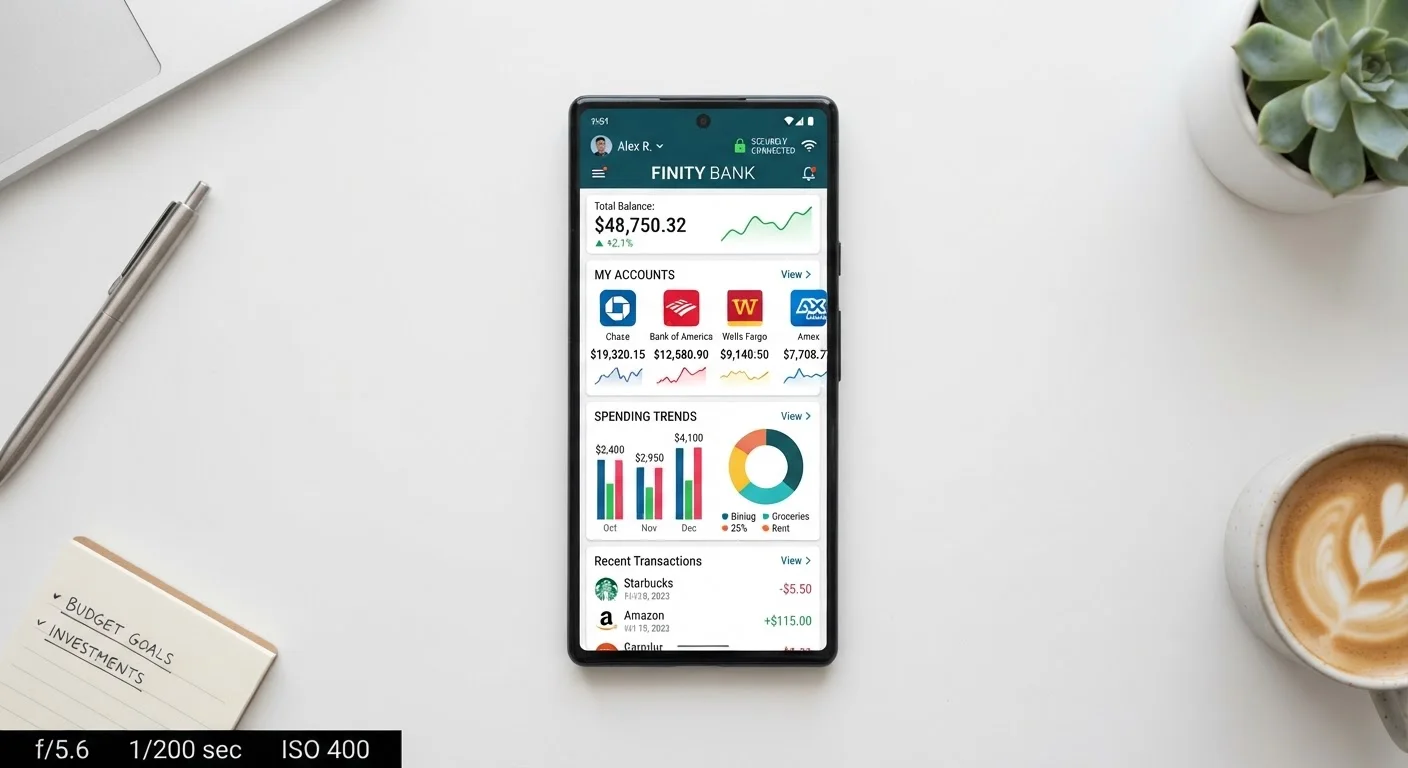
Photo: MoneyOnMind.net | Navigate Money With Clarity editorial
Why This Glossary Exists
Connecting your checking account to a budgeting app sounds simple - until the setup screen asks whether you want to use OAuth, warns about read-only access, or prompts you to enter credentials through a data aggregator. These aren't arbitrary tech terms; each one has real implications for your privacy, security, and the accuracy of your financial picture.
This reference covers the vocabulary you'll most commonly encounter when linking accounts across banking and budgeting platforms. For a broader foundation on account types and how they work, see The Full Picture on Bank Accounts. For a deeper look at the infrastructure powering these connections, Open Banking: The Infrastructure Behind Your Favourite Money Apps is worth reading alongside this guide.
Account Aggregator
A service - often embedded inside a budgeting or personal finance app - that pulls transaction data from multiple financial institutions into a single view. Aggregators typically connect via direct API partnerships or, where unavailable, through screen scraping.
API (Application Programming Interface)
A standardized digital channel that lets two software systems exchange data securely. When your bank offers an API, third-party apps can request your account data without needing your login credentials.
OAuth
An industry-standard authorization protocol that lets you grant a third-party app limited access to your bank account without sharing your password. You log in directly at your bank's site, which then issues a token the app uses for future data requests.
Access Token
A temporary, encrypted credential issued by your bank after you authorize a third-party connection via OAuth. The token grants the app specific permissions for a defined period and can usually be revoked through your bank's security settings.
Screen Scraping
An older data-collection method where an aggregator app logs into your bank using your actual username and password, then copies transaction data from the page. Most major banks and regulators discourage this method because it requires sharing credentials and offers fewer security controls than API-based access.
Read-Only Access
A permission level that allows a connected app to view your account data - balances, transactions, account numbers - but not to move funds or change settings. Most budgeting apps operate on read-only access.
Open Banking
A regulatory and technical framework that requires financial institutions to share customer data with authorized third parties via secure APIs, provided the customer gives consent. Adoption and rules vary significantly by country; the US framework is still evolving.
Data Permissioning
The process by which you - the account holder - define exactly what data a third-party app can access, for how long, and for what purpose. Strong permissioning controls let you limit access to only the accounts or data fields an app actually needs.
Webhook
An automated notification sent from a bank or financial platform to a connected app the moment a specified event occurs, such as a new transaction posting. Webhooks allow real-time balance and transaction updates without the app repeatedly polling for changes.
Tokenization
The replacement of sensitive account details (such as a full account number) with a randomized string called a token. If the token is intercepted, it cannot be used to access the underlying account without the tokenization system's decryption key.
Permission Scope
The specific set of data fields or actions an app is authorized to access. A narrow scope might allow only checking-account balances; a broad scope might include transaction history, linked cards, and investment account data.
Re-authentication
A security step that requires you to verify your identity again - typically via your banking password or multi-factor authentication - after a connected app's access token expires or after a security event triggers the bank to reset active sessions.
Key Stats at a Glance
Before diving into definitions, a few numbers frame the scale of account linking in everyday personal finance today.
~200M
US consumers with at least one linked financial app
Industry estimates suggest roughly 200 million Americans have connected a financial account to a third-party app, though precise figures vary by source and year.
48%
Consumers concerned about data privacy in fintech apps
According to a Pew Research Center survey on digital privacy, nearly half of US adults express concern about how financial apps use their data.
60-90 days
Typical OAuth token lifespan before re-authentication
Most major US banks expire third-party access tokens within 60-90 days as a security measure, requiring periodic re-authorization.
Understanding the terminology below helps you make informed decisions about which permissions you grant and which apps genuinely earn your trust. If you manage shared finances, also consider how linked accounts interact with joint account arrangements - data permissions extend to every account holder.
| Most common connection method | OAuth-based API (replacing screen scraping in most major banks) (Financial Data Exchange (FDX) industry guidance) |
| Typical token expiry | 90 days (varies by institution) (Common industry practice; check your bank's settings) |
| Regulatory body (US) | CFPB oversees consumer data rights under Dodd-Frank Section 1033 (Consumer Financial Protection Bureau) |
| How to revoke access | Through your bank's connected apps or security dashboard |
| FDIC deposit protection | Applies to the underlying bank account, not the aggregator app itself (FDIC.gov) |
| Permission scope risk | Broader scopes increase data exposure if the third-party app is breached (General cybersecurity best practice) |
This article is for general informational and educational purposes only. It does not constitute financial, legal, or security advice tailored to your individual circumstances. Consult a qualified financial professional before making decisions about your accounts or data-sharing arrangements.
The content on this site is for informational purposes only and is not a substitute for professional advice. Always consult a qualified professional for guidance specific to your situation.