
Real-Time Payments vs Scheduled Transfers: Choosing the Right Method

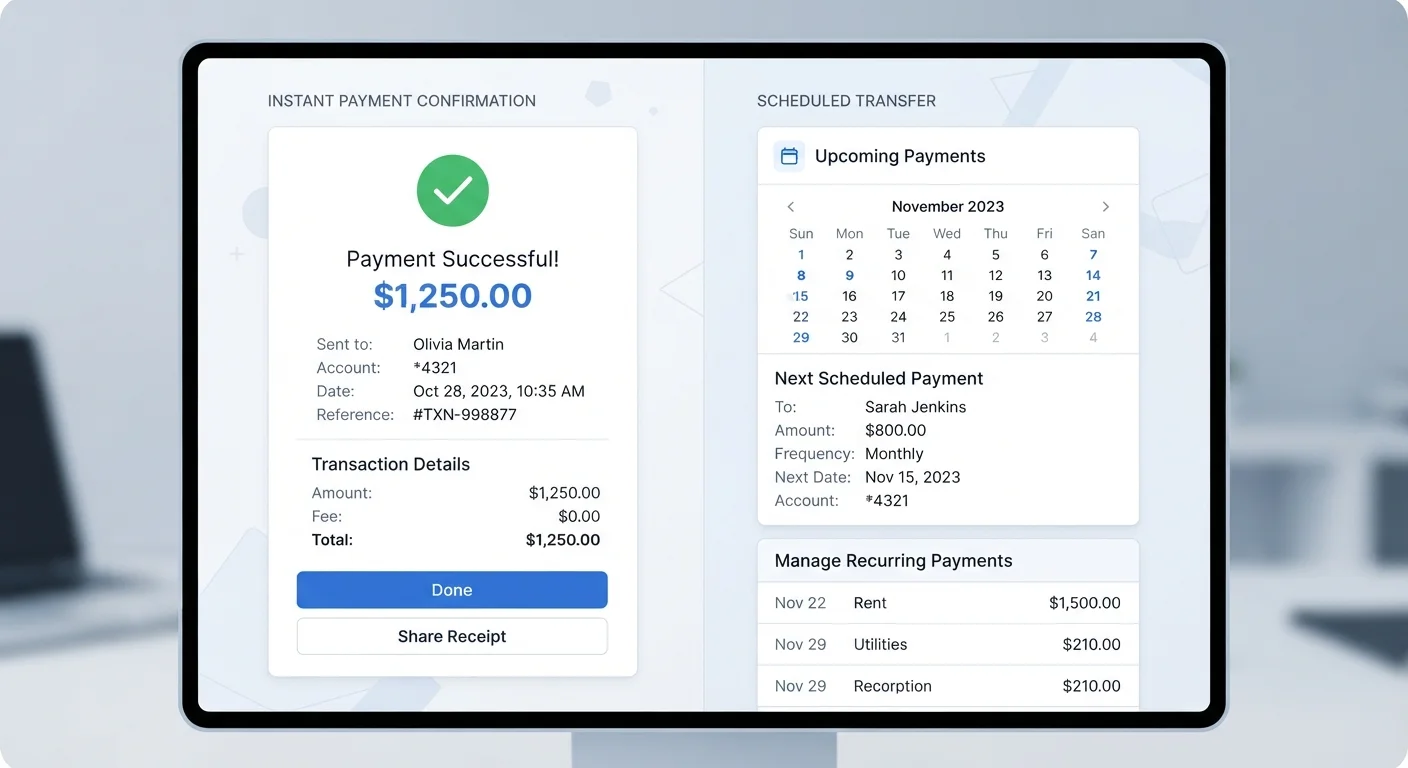
Photo: MoneyOnMind.net | Navigate Money With Clarity editorial
Key Takeaways
- Real-time payments settle within seconds, while scheduled transfers execute on a predetermined future date.
- Real-time payments may carry per-transaction fees; scheduled transfers are typically free through your bank.
- Scheduled transfers reduce the risk of missed payments by automating recurring financial obligations.
- Real-time payment networks like RTP and FedNow operate 24/7, including weekends and holidays.
- Combining both methods strategically can improve cash flow management and reduce financial stress.
How Each Transfer Method Actually Works
Understanding the mechanics behind each method helps you choose the right tool for each financial task - and avoid costly mistakes.
Real-time payments (also called instant payments) are processed through networks like The Clearing House's RTP® network or the Federal Reserve's FedNow® Service. When you initiate a transfer, funds move directly between bank accounts and are typically available to the recipient within seconds - any time of day, any day of the year. There's no batch processing, no overnight delay. The transaction is final and irrevocable once sent, which means errors can be difficult or impossible to reverse.
Scheduled transfers, by contrast, are instructions you set in advance through your bank or credit union's online platform. You specify an amount, a destination account, and a future date (or a repeating interval). The transfer executes automatically when that date arrives, typically as an ACH (Automated Clearing House) transaction, which settles in one to two business days. Many banks allow you to schedule transfers weeks or months ahead, making them ideal for predictable, recurring payments.
| Criterion | Real-Time Payments | Scheduled Transfers |
|---|---|---|
| Settlement Speed | Seconds (24/7) | 1-2 business days |
| Typical Cost | May carry a small fee | Usually free |
| Reversibility | Generally irrevocable | Can be cancelled before execution |
| Best Use Case | Urgent or one-time transfers | Recurring, predictable payments |
| Availability | Depends on bank enrollment | Widely available at most banks |
| Error Risk | Higher - no recall guarantee | Lower - editable before date |
It's worth noting that not all banks have enrolled in FedNow or the RTP network yet. Confirm with your institution whether real-time payments are available before you rely on them in an urgent situation.
When Speed Costs You - and When It Saves You
Real-time payments come with a trade-off: some banks and payment apps charge a fee for instant transfers, typically ranging from $0.25 to a small percentage of the transaction amount. This is usually optional - a slower, free alternative is often available. For occasional urgent transfers, that fee is a reasonable price for certainty. For frequent use, those charges can accumulate.
Scheduled transfers, by comparison, are almost universally free through traditional bank accounts. Their cost is the lead time required: if you schedule a payment today for a bill due tomorrow, an ACH transfer may not clear in time.
$127B+
RTP network transaction value in 2023
According to The Clearing House, the RTP network processed over $127 billion in transactions in 2023, reflecting rapid adoption of instant payments.
0.5-1.75%
Typical instant transfer fee range
Many consumer apps charge between 0.5% and 1.75% for instant transfers, compared to free standard ACH transfers that take one to three business days.
The smarter approach for many young professionals is a hybrid strategy. Use scheduled transfers to automate the predictable - monthly rent, loan installments, savings goals. Use real-time payments selectively for genuinely urgent needs. For more on building automated financial routines, see our guide to banking automation features that make a genuine difference.
One area where this decision carries extra weight is loan repayment. Missing a due date because you misjudged ACH processing time can trigger late fees or affect your credit. Scheduling loan payments several days early removes that risk. Learn more about structuring repayment plans in our article on fixed vs. income-driven repayment.
Double-Check Before You Send Instantly
This article is for general informational purposes only and does not constitute personalized financial advice. Consult a licensed financial professional for guidance specific to your situation.
The content on this site is for informational purposes only and is not a substitute for professional advice. Always consult a qualified professional for guidance specific to your situation.