
Credit Utilisation: The Ratio That Moves Your Score More Than You Think

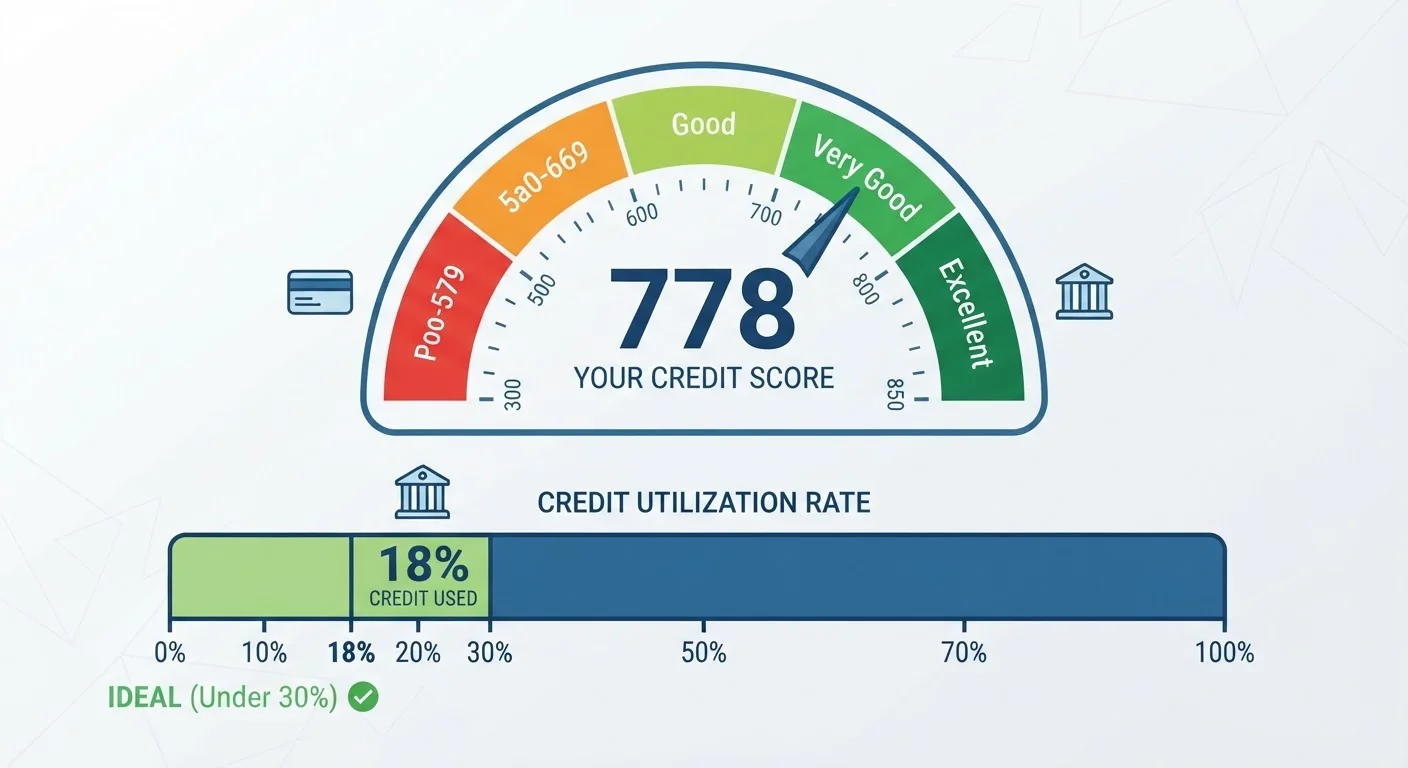
Photo: MoneyOnMind.net | Navigate Money With Clarity editorial
Key Takeaways
- Credit utilisation accounts for roughly 30% of a FICO score, making it the second most influential factor after payment history.
- Keeping utilisation below 30% is widely recommended, but staying under 10% tends to produce the best scoring outcomes.
- Utilisation is not a permanent mark - it resets with each billing cycle, so improvements show up quickly.
- The date your lender reports your balance to credit bureaus determines which number actually affects your score.
- Increasing your credit limit can lower your utilisation ratio without requiring you to spend less.
Why Utilisation Carries So Much Weight
Among the five factors inside every credit score, amounts owed - the category that includes credit utilisation - makes up approximately 30% of a FICO score. Only payment history ranks higher. That single data point means a spike in your utilisation ratio can drag your score down meaningfully, even if everything else about your credit profile is solid.
Lenders use utilisation as a proxy for financial stress. A borrower using 80% of their available credit looks riskier than one using 15%, even if both make every payment on time. It signals how dependent you are on borrowed money at any given moment.
~30%
Share of FICO score tied to amounts owed
According to FICO's publicly published score factor weightings, amounts owed - including credit utilisation - is the second most influential scoring category.
<10%
Utilisation rate seen among highest scorers
FICO data consistently shows that consumers in the highest score ranges tend to use less than 10% of their available revolving credit.
1 month
Time to see score impact after reducing utilisation
Because balances are reported monthly, a reduction in credit card balances can show up in your score within a single billing cycle.
How the Calculation Actually Works
The formula is straightforward: divide your total revolving balances by your total revolving credit limits, then multiply by 100. If you carry $1,500 across three cards with a combined limit of $9,000, your utilisation is about 16.7%.
What many people miss is that scoring models calculate utilisation twice - once at the aggregate level across all accounts, and once per individual account. A card maxed out at $500 on a $500 limit registers as 100% utilisation on that card, which can damage your score even if your overall ratio is low. This is one of the more counterintuitive aspects of how credit scores work, as explained in our overview of how credit reports and scores interact.
Only revolving accounts - credit cards and lines of credit - factor into this ratio. Installment loans like auto loans or student loans are evaluated separately and don't affect your utilisation percentage.
The Timing Factor Most People Overlook
Your credit score doesn't reflect your current balance - it reflects the balance your lender reported to the credit bureaus, which typically happens on your statement closing date. If your closing date is the 15th and you pay your bill on the 20th, the higher pre-payment balance is what the bureau sees that month.
This means you can carry a card to $900 and pay it in full without penalty to your credit score - as long as you pay before the statement closes. For scoring purposes, what matters is the number reported, not whether you ultimately pay in full.
Pay Before Your Statement Closes, Not Just By the Due Date
If you're preparing for a major credit application - a mortgage or auto loan, for instance - planning payments around your statement closing dates can meaningfully lower the utilisation reported in the weeks before lenders pull your file.
Practical Ways to Lower Your Ratio
There are two sides to the utilisation fraction: your balances (the numerator) and your limits (the denominator). Most people focus only on reducing balances, but increasing available credit is an equally valid approach.
- Request a credit limit increase on existing cards. If your spending stays flat but your limit rises from $5,000 to $8,000, your utilisation drops automatically.
- Pay down balances before your statement closes, not just before the due date.
- Spread spending across multiple cards rather than concentrating charges on one, to avoid high per-card utilisation.
- Avoid closing unused cards unless there's a compelling reason - removing a limit raises your overall ratio.
It's also worth knowing that utilisation has no memory. Unlike a late payment, which can remain on your credit report for seven years, a high utilisation ratio disappears from your score the moment a lower balance is reported. This makes it one of the fastest levers available for improving your standing.
This article provides general financial education and is not personalised financial or credit advice. Consult a qualified financial professional for guidance specific to your situation.
Frequently Asked Questions
The content on this site is for informational purposes only and is not a substitute for professional advice. Always consult a qualified professional for guidance specific to your situation.