
The Five Factors Inside Every Credit Score

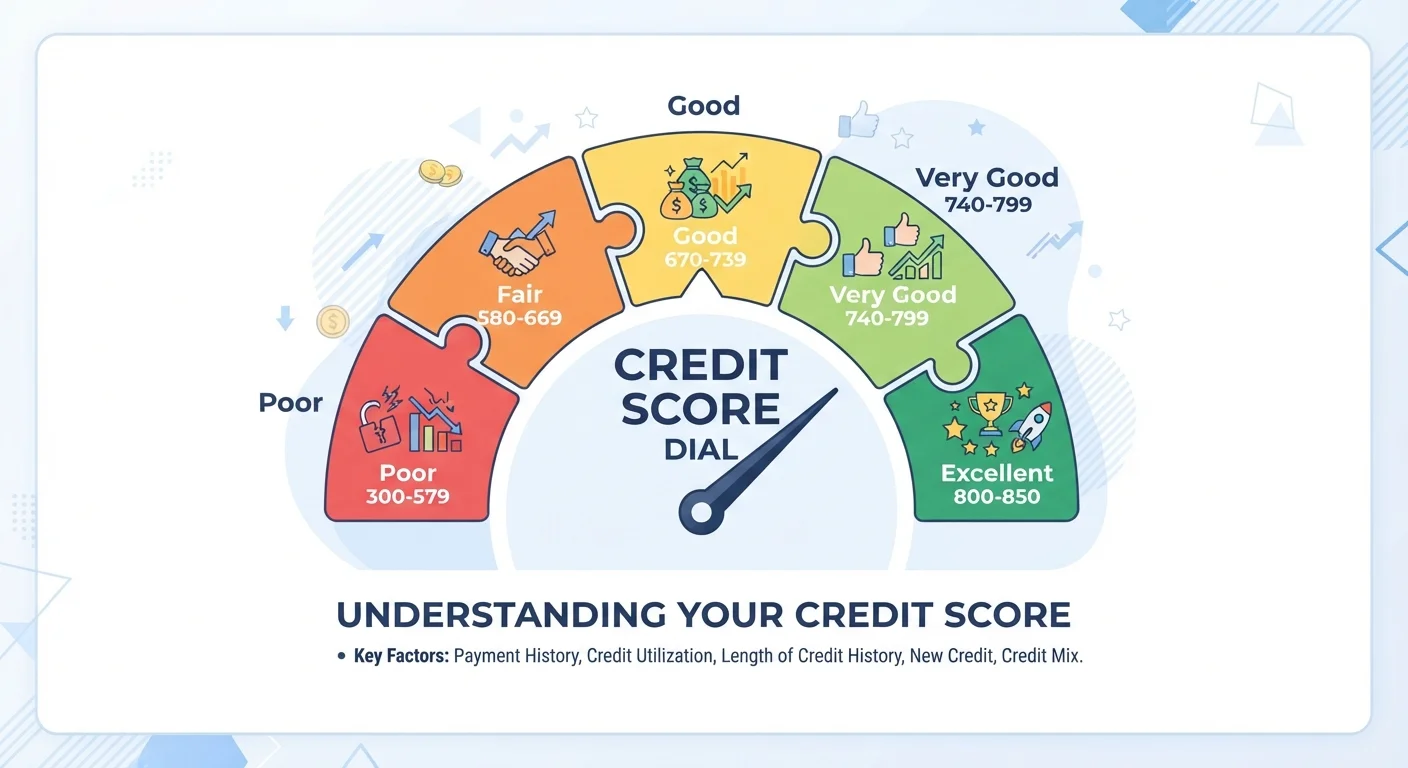
Photo: MoneyOnMind.net | Navigate Money With Clarity editorial
How Credit Scores Are Built
Your credit score isn't a mystery - it's a formula. The most widely used scoring models, including FICO, calculate your score by weighing five specific categories of information pulled from your credit report. Understanding each factor gives you a clear map of where your score comes from and which behaviors move the needle most.
If you're just getting started, our beginner's guide to credit scores lays out the foundational concepts before you dive into the breakdown below.
| Payment History Weight | 35% of FICO Score (FICO scoring model) |
| Amounts Owed Weight | 30% of FICO Score (FICO scoring model) |
| Length of Credit History Weight | 15% of FICO Score (FICO scoring model) |
| Credit Mix Weight | 10% of FICO Score (FICO scoring model) |
| New Inquiries Weight | 10% of FICO Score (FICO scoring model) |
| Recommended Utilisation Threshold | Below 30% (General consumer credit guidance) |
The Five Factors, Explained
1. Payment History - 35%
This is the single largest factor. Lenders want to know whether you pay your bills on time. Every on-time payment strengthens this category; every late or missed payment damages it. Even one payment that is 30 or more days late can have a meaningful negative impact. The good news: consistent on-time payments rebuild this factor over time.
2. Amounts Owed (Credit Utilisation) - 30%
This measures how much of your available revolving credit you're currently using - commonly called your credit utilisation ratio. Using a high percentage of your available credit signals financial stress to lenders. Most credit educators suggest keeping utilisation below 30%, though lower is generally better. For a deeper look at how this calculation works and why timing matters, see our article on credit utilisation and your score.
3. Length of Credit History - 15%
Older accounts work in your favor. This factor considers how long your oldest account has been open, how long your newest account has been open, and the average age of all accounts. Closing old credit cards can unintentionally shorten your average account age and lower your score, even if the cards carry no balance.
4. Credit Mix - 10%
Lenders prefer to see that you can manage different types of credit responsibly. A healthy mix typically includes revolving accounts (like credit cards) alongside installment accounts (like auto loans or student loans). You don't need every type of account - but having only one kind can limit your score's ceiling.
5. New Credit Inquiries - 10%
Every time you apply for new credit, the lender performs a hard inquiry on your report. A single inquiry has a small, short-lived effect - typically a few points for up to 12 months. But multiple applications in a short window can signal elevated risk. Rate-shopping for mortgages or auto loans within a focused timeframe is generally treated as a single inquiry by most scoring models.
Credit Utilisation Ratio
The percentage of your total available revolving credit that you are currently using. It is calculated by dividing your total revolving balances by your total revolving credit limits.
Hard Inquiry
A record created on your credit report when a lender reviews your credit as part of a formal application for new credit. Hard inquiries can slightly lower your score for up to 12 months.
Revolving Credit
A type of credit account with a flexible borrowing limit, such as a credit card or home equity line of credit, where you can borrow, repay, and borrow again.
Installment Account
A credit account with a fixed loan amount repaid in equal scheduled payments over a set term, such as a student loan, mortgage, or auto loan.
Credit Mix
The variety of credit account types on your credit report. Lenders view a diverse mix - including both revolving and installment accounts - as a sign of broader credit management experience.
Putting the Factors to Work
Because payment history and amounts owed together account for 65% of your score, they deserve the most attention. Set up autopay to protect your payment record, and monitor your utilisation regularly - it can shift month to month based on your balances and your lender's reporting cycle.
The remaining three factors reward patience. Credit age grows on its own; credit mix improves naturally as your financial life expands; and new inquiries fade within a year. Focus on the high-weight factors first, and the lower-weight ones will tend to improve as a byproduct of responsible borrowing habits.
To understand what your resulting score actually means to a lender, read our guide on credit score ranges and what each band signals.
Scoring Models Vary by Lender
This article is for general informational and educational purposes only. It does not constitute personalized financial or credit advice. Credit scoring models vary, and individual results depend on your specific credit profile. Consult a qualified financial professional for guidance tailored to your situation.
The content on this site is for informational purposes only and is not a substitute for professional advice. Always consult a qualified professional for guidance specific to your situation.