
Credit Score Ranges Explained: What Each Band Signals to Lenders

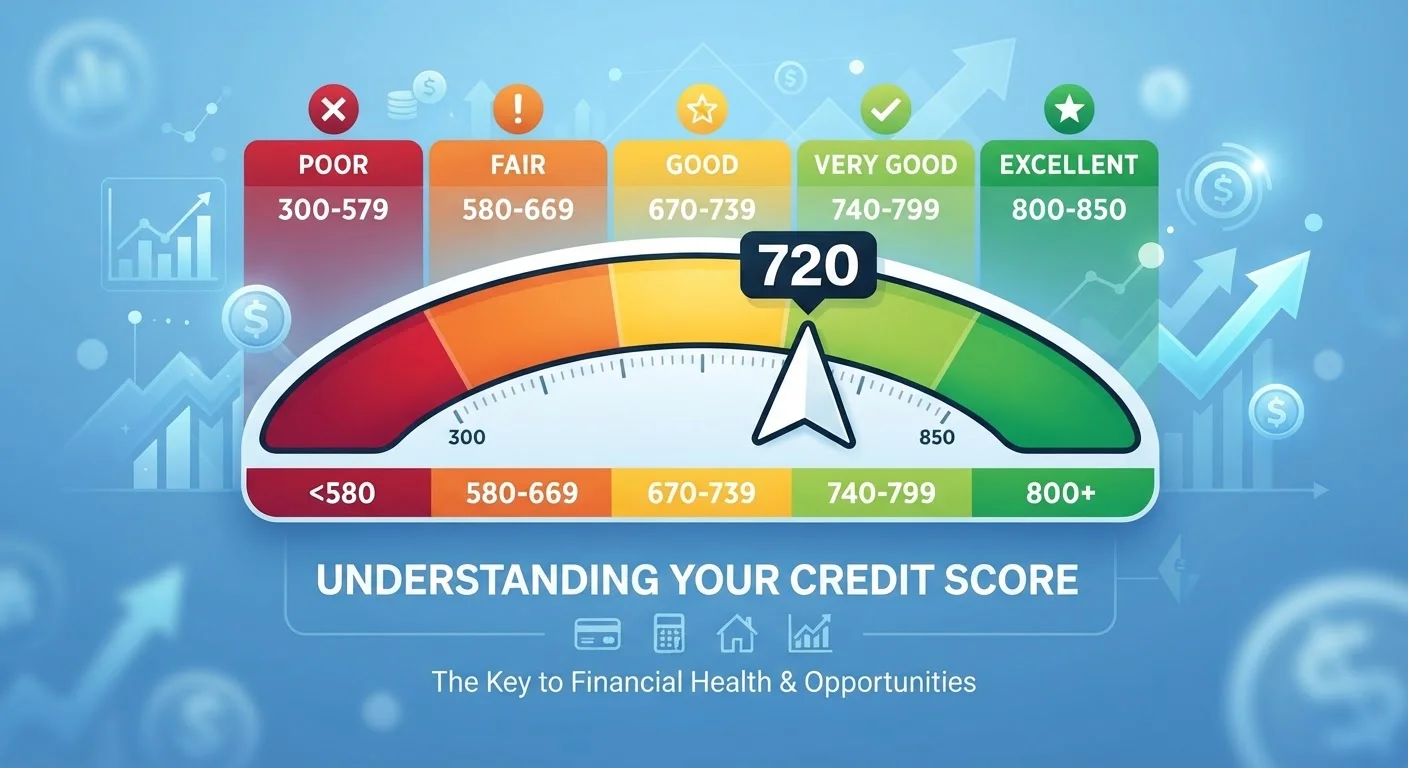
Photo: MoneyOnMind.net | Navigate Money With Clarity editorial
Key Takeaways
- Credit scores run from 300 to 850 and are grouped into bands that lenders use to assess risk.
- A score of 670 or above is generally considered 'Good' under the FICO model and opens up most mainstream lending options.
- Each band carries real consequences: lower scores typically mean higher interest rates or outright denials.
- Moving up even one band can meaningfully reduce borrowing costs over time.
- Your score is not fixed - consistent positive habits can shift you into a better range.
The 300-850 Scale: How It's Structured
If you're new to credit, start with the basics: your credit score is a three-digit number that summarizes your credit history into a single figure lenders can quickly assess. If you haven't explored that foundation yet, our complete credit score starting guide covers how scores are built and what goes into them.
The FICO Score - the model most US lenders use - runs from 300 to 850. That 550-point span is divided into five named bands:
- Exceptional: 800-850
- Very Good: 740-799
- Good: 670-739
- Fair: 580-669
- Poor: 300-579
VantageScore uses the same 300-850 range but draws its band boundaries slightly differently. Because lenders choose which model to use, your score can look different depending on the platform or bureau pulling it - see our article on why scores differ across bureaus for a full explanation.
716
Average US FICO Score
According to FICO's publicly reported data, the average American FICO Score sits in the Good range, meaning most consumers have at least basic access to mainstream credit products.
~21%
Consumers with Exceptional scores (800+)
FICO has reported that roughly one in five US consumers scores 800 or above, placing them in the Exceptional tier where the best lending terms are typically available.
580
Common FHA loan minimum score
Many FHA-backed mortgage programs set a floor of 580 for borrowers making a 3.5% down payment, illustrating how score thresholds directly gate access to specific loan products.
What Each Band Signals to a Lender
Lenders use credit score bands as a fast proxy for risk. Here's what each tier communicates in practice:
Poor (300-579)
A score in this range signals significant past credit difficulties - late payments, collections, charge-offs, or very limited credit history. Many traditional lenders will decline applications outright, and those that do approve typically impose high interest rates and low credit limits. Secured credit cards and credit-builder loans are often the most accessible starting points.
Fair (580-669)
Fair-range borrowers are generally considered subprime. Approval odds improve compared to Poor, but terms remain unfavorable. You may qualify for personal loans and some auto financing, though rates will be considerably above average.
Good (670-739)
This is the threshold where most mainstream lending becomes accessible. You'll typically qualify for unsecured credit cards, personal loans, and conventional mortgages. Rates won't be the lowest available, but they're unlikely to be punishing.
Very Good (740-799)
Lenders view this range favorably and often offer near-prime rates. You'll have access to premium credit products and may be able to negotiate better terms.
Exceptional (800-850)
The top tier signals very low risk. Lenders compete for borrowers here, offering their best rates, highest limits, and most favorable terms. Reaching this band typically requires years of on-time payments, low utilization, and a diverse credit mix.
“Your credit score is a snapshot, not a sentence. The bands exist to help lenders make fast decisions, but every consumer has the ability to shift that snapshot over time through consistent financial behavior.”
— Credit Basics Editorial Team, Finance educators and credit specialists
Why the Band You're In Has Real Financial Consequences
The difference between a Fair score and a Good score isn't just a label - it can translate into thousands of dollars in extra interest paid over the life of a loan. On a 30-year fixed-rate mortgage, for example, a borrower in the Fair range might pay a meaningfully higher rate than someone in the Very Good range, compounding significantly over time.
Understanding what lenders actually see when they pull your credit report can help you appreciate that your score is just one part of the picture - but it's an important first filter.
Small Score Gains Can Have Outsized Impact
Lenders also use your score to set credit limits and security deposit requirements for utilities or rental housing. A lower score can mean paying a deposit where a higher-score applicant pays nothing.
For a fuller picture of the data behind your score, exploring your credit report is a logical next step - it shows the underlying account history that drives your number.
Moving Between Bands: What Actually Works
Your score is dynamic. The factors that move it most - payment history and credit utilization - are also the ones most within your control. Paying every bill on time and keeping revolving balances below 30% of your available credit limit are the two highest-impact habits you can build.
If you're working to build from the ground up or recover from past mistakes, the Building Credit hub provides practical strategies suited to different starting points. If your report contains errors that are dragging your score into a lower band than it should be, understanding account status codes can help you identify and dispute inaccuracies.
Progress between bands is rarely instant, but it is predictable. Consistent behavior - not one dramatic action - is what shifts scores over time.
This article is for general informational and educational purposes only and does not constitute personalized financial or credit advice. Credit score models, lender requirements, and eligibility criteria vary. Consult a qualified financial professional for guidance specific to your situation.
Frequently Asked Questions
The content on this site is for informational purposes only and is not a substitute for professional advice. Always consult a qualified professional for guidance specific to your situation.