
Your Complete Starting Point for Understanding Credit Scores

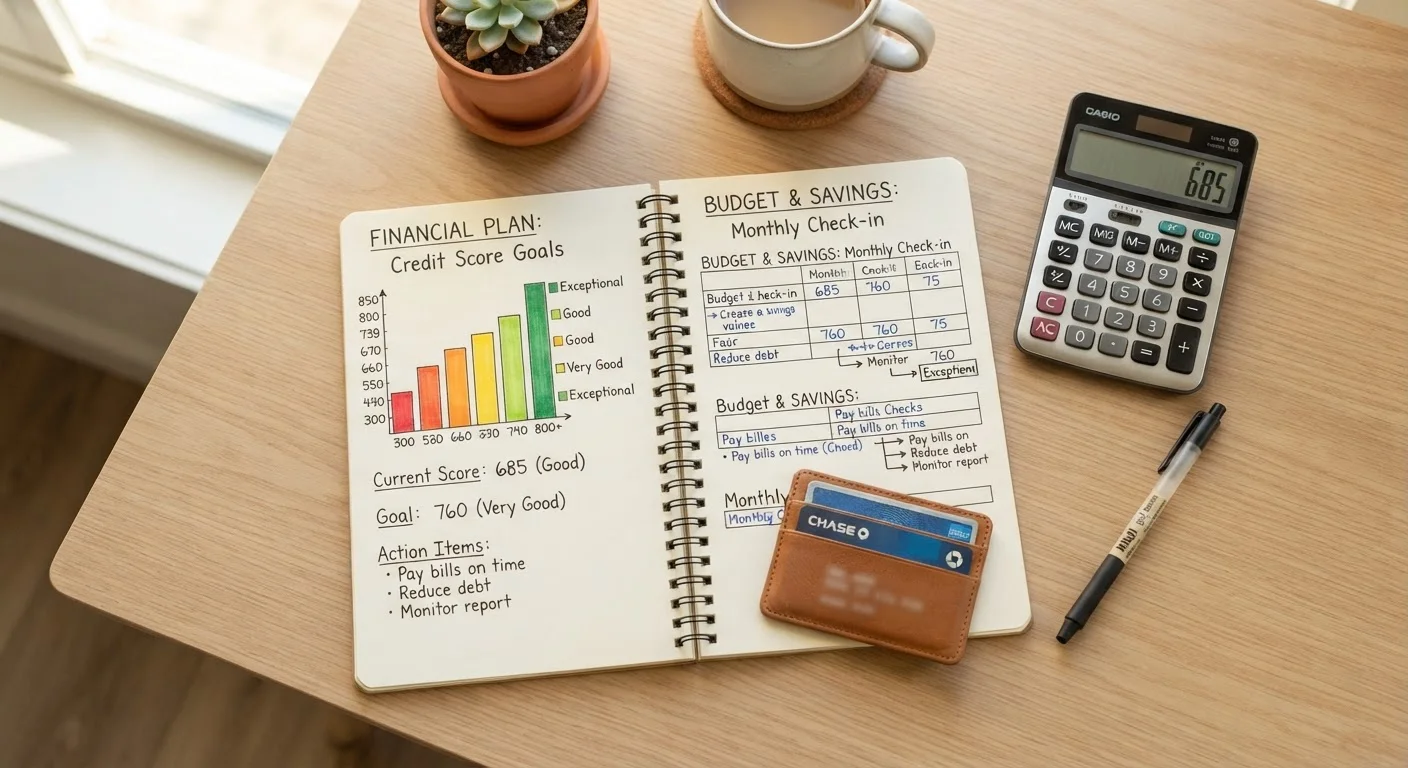
Photo: MoneyOnMind.net | Navigate Money With Clarity editorial
Key Takeaways
- A credit score is a three-digit number that summarizes how reliably you've managed borrowed money.
- Payment history carries the most weight - paying on time is the single most impactful habit.
- Scores range from 300 to 850; most lenders consider 670 and above to be a good starting threshold.
- You can begin building credit even with no borrowing history using secured cards or credit-builder loans.
- Checking your own credit score never lowers it - it counts as a soft inquiry.
What Is a Credit Score?
A credit score is a three-digit number - typically between 300 and 850 - that represents how reliably you've managed credit and debt. Lenders, landlords, and sometimes employers use it as a fast snapshot of your financial trustworthiness.
In the US, the most widely used scoring model is the FICO Score, developed by the Fair Isaac Corporation. VantageScore is another common model used by many banks and free monitoring tools. While their exact formulas differ, both draw from the same source: your credit report.
Your credit report is the detailed record of your borrowing history - every account, balance, and payment pattern. Think of the report as the full story and the score as the summary. To learn how to read that story in depth, see Your First Credit Report: A Complete Walkthrough.
Credit Score
A three-digit number (300-850) that summarizes your borrowing track record. Lenders use it to quickly assess how likely you are to repay new debt.
Credit Report
A detailed record of your credit accounts, payment history, and public financial records. Credit scores are calculated from this data.
Credit Utilization
The percentage of your available credit limit you're currently using. For example, a $500 balance on a $1,000 limit card equals 50% utilization.
Hard Inquiry
A credit check triggered when you apply for new credit. It can temporarily lower your score by a small amount and stays on your report for up to two years.
Secured Credit Card
A credit card backed by a cash deposit you provide upfront. It functions like a regular card and reports to credit bureaus, making it a common tool for building credit history.
Credit-Builder Loan
A small loan designed to help people establish credit history. Payments are reported to the credit bureaus, and the loan funds are typically released to you after the loan term ends.
How Credit Scores Are Calculated
Credit scores aren't arbitrary. They're calculated from five weighted categories, each reflecting a different aspect of your borrowing behavior.
- Payment history (~35%): Whether you pay on time. A single missed payment can noticeably lower your score.
- Credit utilization (~30%): How much of your available credit you're using. Keeping usage below 30% of your total limit is a widely cited guideline.
- Length of credit history (~15%): How long your accounts have been open. Older accounts help; closing them can shorten your average age.
- Credit mix (~10%): Having a variety of account types - installment loans, revolving credit - can be a small positive signal.
- New inquiries (~10%): Applying for several new accounts in a short window can temporarily reduce your score.
For a detailed breakdown of how each factor is weighted, The Five Factors Behind Every Credit Score goes deeper on each component.
The Single Most Impactful Habit
Score Ranges and What They Mean
Understanding where a score falls helps you interpret what lenders see when they pull your file.
| Score Range | General Label | Typical Impact |
|---|---|---|
| 300-579 | Poor | Limited approval options; higher interest rates likely |
| 580-669 | Fair | Some approvals available; rates may still be elevated |
| 670-739 | Good | Broadly acceptable to most mainstream lenders |
| 740-799 | Very Good | Access to competitive rates and favorable terms |
| 800-850 | Exceptional | Best available rates; strong negotiating position |
These ranges are general guidelines, not guarantees. Individual lenders set their own approval thresholds, and the same score can yield different outcomes depending on the lender and the product.
Scores Vary by Model and Bureau
Building Your Credit from the Ground Up
If you have little or no credit history, you're not starting at zero - you're starting with a blank slate, which is workable. Here are concrete first steps:
- Open a secured credit card. You deposit funds as collateral, which sets your credit limit. Use it for small purchases and pay in full each month.
- Consider a credit-builder loan. Offered by many credit unions and community banks, these small loans are designed specifically to help people establish history.
- Become an authorized user. A family member with a strong credit history can add you to their account, letting their positive history appear on your report.
- Pay every bill on time. Payment history is the largest factor. Set up autopay for at minimum the minimum payment to avoid accidental misses.
- Monitor your credit report. You're entitled to free weekly reports from all three major bureaus (Equifax, Experian, TransUnion) at AnnualCreditReport.com. Once you have a report, learn to read it using Reading Your Credit Report for the First Time.
If debt is already a concern alongside credit-building, Your First Steps Out of Debt: A Practical Starting Point provides a grounded starting framework.
AnnualCreditReport.com
The official, federally authorized source for free weekly credit reports from all three major bureaus - Equifax, Experian, and TransUnion. Reviewing your report regularly is one of the simplest ways to catch errors and track your progress.
Consumer Financial Protection Bureau (CFPB) Credit Resources
The CFPB publishes plain-language guides on credit scores, credit reports, and consumer rights under federal law. A reliable starting point for understanding your legal protections as a borrower.
Building Credit Hub
Our own Building Credit hub collects practical strategies for establishing and improving your credit history, from secured cards to dispute processes.
Common Misconceptions to Clear Up
A few persistent myths cause unnecessary anxiety or lead to counterproductive decisions:
- Myth: Checking your own score hurts it.
- It doesn't. Self-checks are soft inquiries and have no scoring impact.
- Myth: You need to carry a balance to build credit.
- Paying your full statement balance monthly is better for your score and saves you interest.
- Myth: Closing old accounts improves your score.
- Closing accounts can reduce your total available credit and shorten your credit history, both of which may lower your score.
- Myth: A higher income means a higher score.
- Income is not a factor in credit scoring models. Your score reflects borrowing behavior only.
The Building Credit hub covers more strategies for establishing and improving your standing over time.
This article is for general informational and educational purposes only and does not constitute personalized financial, legal, or credit advice. Credit scoring models, lender criteria, and product availability vary. Consult a qualified financial professional for guidance specific to your situation.
Frequently Asked Questions
The content on this site is for informational purposes only and is not a substitute for professional advice. Always consult a qualified professional for guidance specific to your situation.