
The Five Factors Behind Every Credit Score

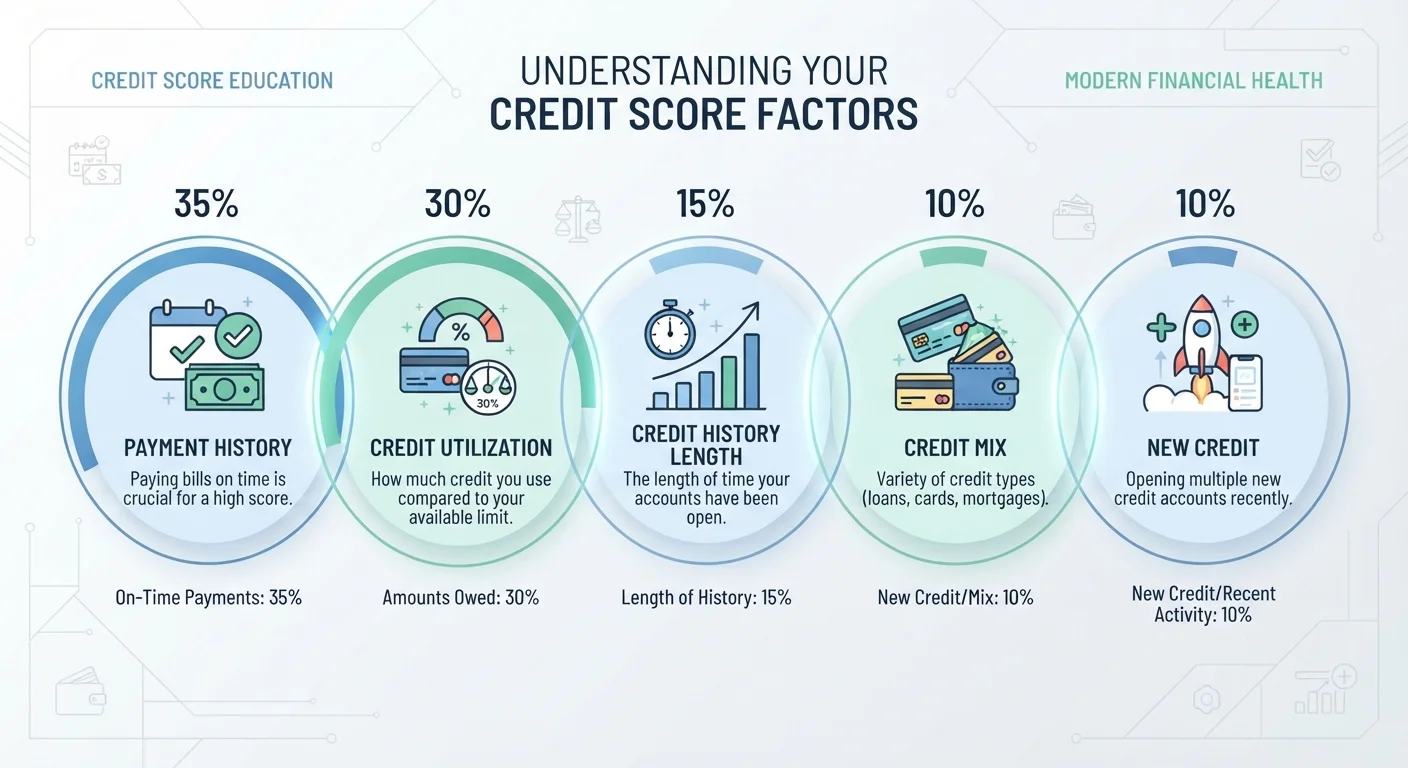
Photo: MoneyOnMind.net | Navigate Money With Clarity editorial
What Actually Goes Into a Credit Score
If you've ever wondered why your score moved without warning - or refused to budge despite months of effort - the answer almost always traces back to one of five specific factors. Credit scoring models, including the widely used FICO® Score, assign weight to each factor differently. Understanding that weighting is the difference between guessing at your score and actively managing it.
| Payment History Weight | 35% (FICO® Score model) |
| Amounts Owed (Utilisation) Weight | 30% (FICO® Score model) |
| Length of Credit History Weight | 15% (FICO® Score model) |
| Credit Mix Weight | 10% (FICO® Score model) |
| New Credit (Hard Inquiries) Weight | 10% (FICO® Score model) |
| Score Range (FICO®) | 300-850 (Fair Isaac Corporation) |
None of this constitutes personalised financial advice. For guidance specific to your situation, consult a licensed financial professional. For a broader introduction to how scores work, see our complete starting point for understanding credit scores.
The Five Factors, Ranked by Weight
1. Payment History - 35%
The single largest factor. Lenders want to know whether you pay on time, every time. A single missed payment - especially one that goes 30 or more days late - can cause a meaningful score drop. Conversely, a consistent track record of on-time payments is the strongest positive signal you can send.
2. Amounts Owed (Credit Utilisation) - 30%
This measures how much of your available revolving credit you're currently using, expressed as a percentage. Using $3,000 of a $10,000 limit means a 30% utilisation rate. Most credit educators suggest keeping this below 30%, with lower being better. For a deeper look at how this ratio works in practice, see how credit utilisation moves your score.
3. Length of Credit History - 15%
Scoring models look at the age of your oldest account, your newest account, and the average age of all accounts. Longer history generally helps, which is why closing an old card - even one you rarely use - can unintentionally lower your score.
4. Credit Mix - 10%
Lenders like to see that you can responsibly manage different types of credit: revolving accounts (credit cards, lines of credit) and instalment accounts (auto loans, student loans, mortgages). You don't need every type, but some variety signals broader financial experience.
5. New Credit (Hard Inquiries) - 10%
Each time you apply for new credit, a hard inquiry is recorded. A single inquiry typically causes only a minor, temporary dip. Multiple applications within a short window can compound the effect, though rate-shopping for mortgages or auto loans within a focused period is often treated as a single inquiry by scoring models.
Hard Inquiry
A formal review of your credit report triggered when you apply for new credit. Hard inquiries are recorded on your credit report and can temporarily lower your score by a small amount.
Credit Utilisation Rate
The percentage of your available revolving credit that you're currently using. It's calculated by dividing your total balances by your total credit limits across revolving accounts.
Revolving Credit
A type of credit with a flexible balance that can be borrowed, repaid, and borrowed again - such as a credit card or line of credit. The limit stays open as you pay it down.
Instalment Account
A loan with a fixed repayment schedule and end date, such as a student loan, auto loan, or mortgage. Payments are the same amount each period until the balance is paid off.
Credit Mix
The variety of credit account types appearing on your credit report, including both revolving and instalment accounts. A diverse mix can positively influence your credit score.
How to Use This Knowledge Practically
The weighting tells you exactly where to focus your energy. Since payment history and utilisation together account for 65% of a FICO® Score, those two areas deliver the highest return on attention. Set up automatic payments to protect your payment history, and monitor your utilisation monthly - especially before applying for new credit.
The remaining 35% matters too, but it tends to move more slowly. Building credit age requires patience; diversifying your credit mix should happen organically as your financial life grows, not through forced account-opening. Limiting hard inquiries is mostly about timing applications thoughtfully.
For strategies on strengthening these factors over time, the Building Credit hub covers practical, step-by-step approaches. And once you understand your score's composition, understanding what each score range signals to lenders is a natural next step.
This article is for general informational and educational purposes only and does not constitute personalised financial or credit advice. Credit scoring models and their weightings can vary. Consult a licensed financial professional for guidance tailored to your individual circumstances.
The content on this site is for informational purposes only and is not a substitute for professional advice. Always consult a qualified professional for guidance specific to your situation.