
Why Your Credit Score Differs Across Bureaus and Platforms

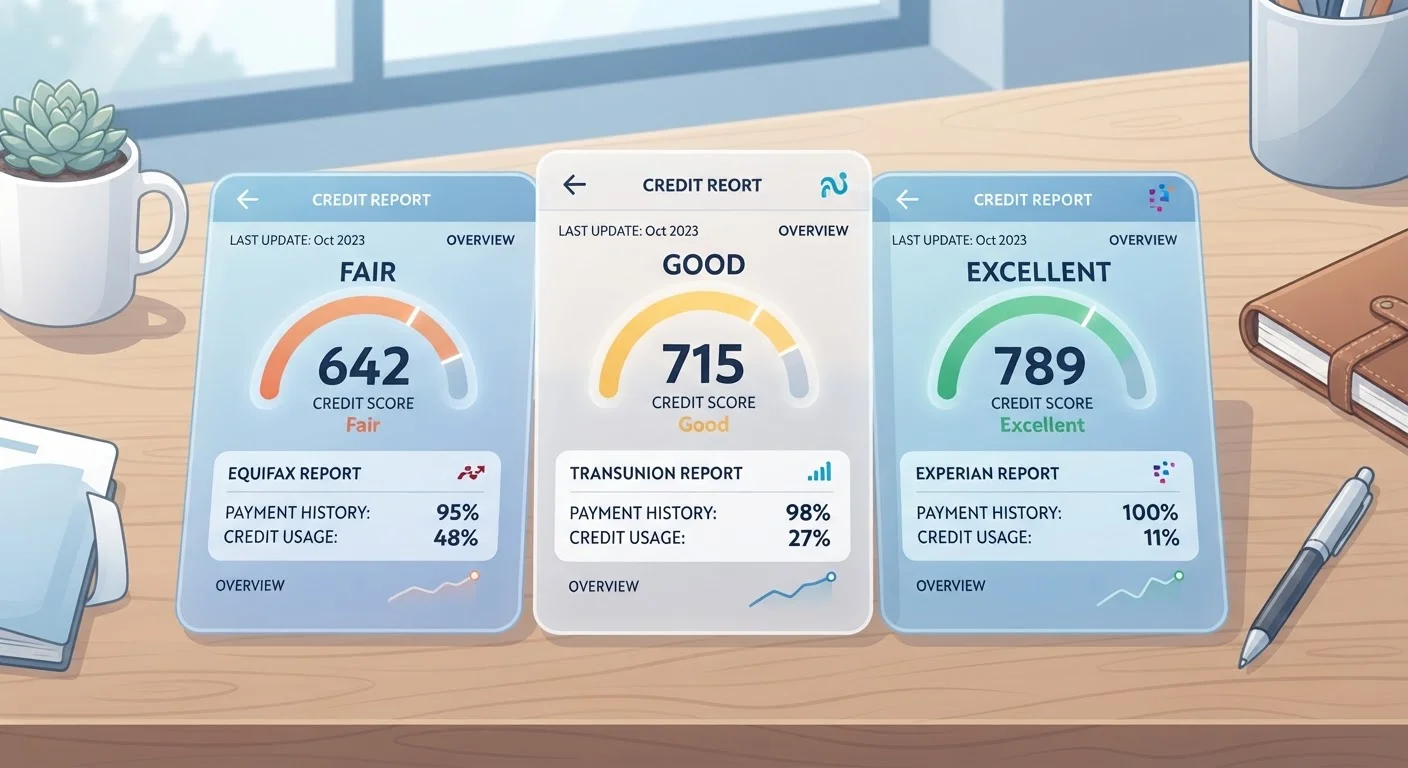
Photo: MoneyOnMind.net | Navigate Money With Clarity editorial
Key Takeaways
- Each credit bureau maintains its own independent data file, so scores can legitimately differ.
- Not all creditors report to all three bureaus, creating data gaps that affect scores.
- FICO and VantageScore use different formulas, producing different numbers from identical data.
- Free score platforms often show VantageScore, while mortgage lenders typically use FICO.
- Focus on the overall trend and credit health rather than obsessing over a single number.
Three Bureaus, Three Independent Files
Equifax, Experian, and TransUnion are three entirely separate companies. They do not share data with each other in real time. Each bureau builds and maintains its own credit file for you, based on the information that creditors and lenders choose to send them.
Here's the catch: creditors are not required by law to report to all three bureaus. A credit card issuer might report your payment history to Experian and TransUnion but skip Equifax entirely. A personal loan lender might report only to TransUnion. As a result, each bureau's file on you can contain a meaningfully different snapshot of your credit activity - and different data produces different scores.
This is why checking your reports at all three bureaus matters. You can access them free at AnnualCreditReport.com, the only federally authorized source. Reviewing all three helps you catch missing accounts, outdated information, or outright errors that could be dragging one score down unfairly. For a deeper look at what those files actually contain, see what lenders actually see when they pull your credit report.
The Scoring Model Layer: FICO vs. VantageScore
Even when two bureaus hold identical data about you, they can still produce different scores - because the scoring model doing the calculation may differ. The two dominant models in the U.S. are FICO and VantageScore. Both analyze the same categories of credit behavior, but they weight those factors differently and handle edge cases - like thin credit files or recent late payments - in distinct ways.
There's an additional layer of complexity: each model has multiple versions. FICO alone has released FICO Score 8, 9, and 10, among others, plus industry-specific variants for mortgage, auto, and credit card lending. A score labeled "720" from FICO Score 8 and one labeled "720" from VantageScore 3.0 are not calculated the same way and may not signal the same risk to a lender.
3
Major U.S. credit bureaus operating independently
Equifax, Experian, and TransUnion each maintain separate consumer credit files with no real-time data sharing between them.
16+
FICO score versions currently in use by lenders
FICO publishes general-purpose and industry-specific score versions, meaning lenders across different sectors may use substantially different formulas.
79%
U.S. adults who have checked their credit score
According to a Consumer Financial Protection Bureau survey, most Americans now monitor their credit, though many are unaware that different platforms show different score types.
Free consumer platforms - including many bank apps and personal finance tools - most commonly display VantageScore 3.0. Mortgage lenders, by contrast, are currently required to use specific FICO versions. This mismatch is the most frequent reason people are surprised when a lender mentions a score that differs from what they checked at home. For a thorough side-by-side breakdown, see FICO Score vs. VantageScore: two models, one credit file.
What Actually Matters: Trends, Not Single Numbers
Understanding score variation shifts the question from "which number is right?" to "what do my numbers tell me collectively?" Because different lenders will pull different bureau scores and different models, no single number is the definitive one. What you can control is the underlying data that all of these models draw from.
Focus on Your Credit Report, Not Just the Score
The factors that drive scores upward are consistent across models: on-time payments, low credit utilization relative to your limits, a mix of account types, and limited new credit inquiries. Keeping those fundamentals healthy moves all your scores in the right direction, regardless of which model a lender uses.
If your scores vary significantly - say, one bureau's score is 60+ points lower than the others - that's a signal to investigate that bureau's file specifically. Look for accounts you don't recognize, incorrect late payment records, or a balance that hasn't been updated. Disputing errors directly with the bureau is your right under the Fair Credit Reporting Act (FCRA). Understanding what each credit score range signals to lenders can also help you interpret where your numbers sit in practical terms.
This article is for general informational purposes only and does not constitute personalized financial or legal advice. For guidance specific to your situation, consult a qualified financial professional.
Frequently Asked Questions
The content on this site is for informational purposes only and is not a substitute for professional advice. Always consult a qualified professional for guidance specific to your situation.