
FICO Score vs. VantageScore: Two Models, One Credit File

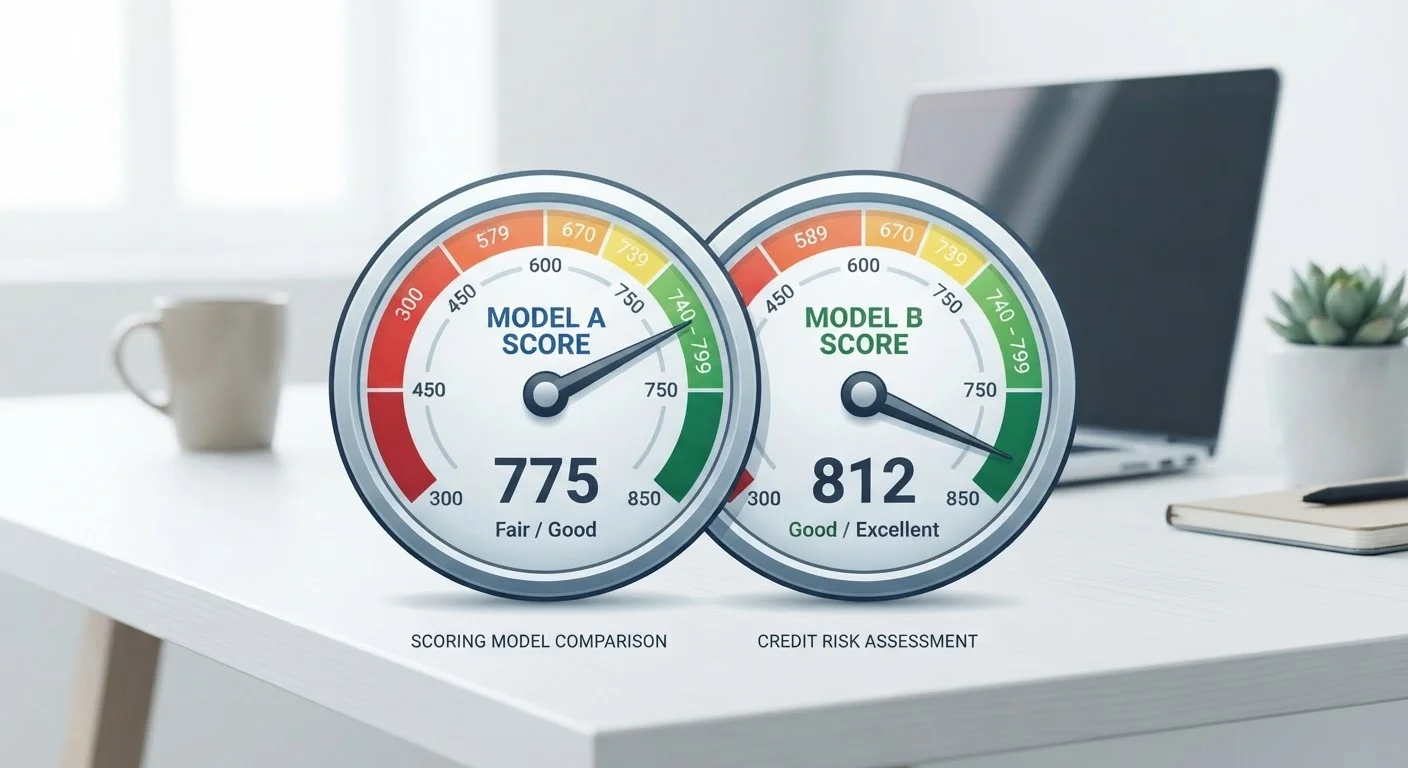
Photo: MoneyOnMind.net | Navigate Money With Clarity editorial
Key Takeaways
- FICO and VantageScore both use the 300-850 scale but apply different weights to credit factors.
- FICO requires at least six months of credit history; VantageScore can score with as little as one month.
- Most mortgage and auto lenders rely on FICO scores for underwriting decisions.
- Free credit monitoring platforms commonly display VantageScores, not FICO scores.
- A gap of 20-50 points between models is normal and does not indicate an error.
- Improving the same core habits - on-time payments, low utilization - raises both scores.
Why Two Scoring Models Exist
When lenders evaluate your creditworthiness, they do not read your credit report line by line. Instead, they rely on a three-digit score distilled from your credit file. That score is generated by a scoring model - a proprietary algorithm that weighs your credit data and outputs a number.
Two models dominate the US market: FICO, created by Fair Isaac Corporation and first introduced in 1989, and VantageScore, launched in 2006 as a joint venture by the three major credit bureaus - Equifax, Experian, and TransUnion. Both models pull from the same underlying credit file, but because their algorithms differ, they can produce meaningfully different numbers for the same person.
Understanding why scores vary across platforms is the first step to making sense of the numbers you encounter. Neither score is the "real" one - both are legitimate representations of your credit risk, calculated differently.
| Criterion | FICO Score | VantageScore |
|---|---|---|
| Score range | 300-850 | 300-850 |
| Created by | Fair Isaac Corporation (1989) | Equifax, Experian, TransUnion (2006) |
| Minimum history to score | 6 months, 1 account | 1 month, 1 account |
| Lender adoption | Used by ~90% of top US lenders | Growing; common in fintech and monitoring |
| Trended data (current version) | FICO 10 T only | VantageScore 4.0 |
| Where you typically see it | Lender disclosures, purchased reports | Free credit monitoring tools |
| Industry-specific versions | Yes (Auto, Bankcard, Mortgage) | No industry-specific versions |
How Each Model Weights Your Credit Data
Both models evaluate the same general categories - payment history, credit utilization, length of credit history, credit mix, and new inquiries - but they assign different weights to each. For a full breakdown of what each factor means, see our guide on the five factors behind every credit score.
FICO breaks its weighting down as follows: payment history accounts for 35%, amounts owed (which includes utilization) for 30%, length of credit history for 15%, new credit for 10%, and credit mix for 10%. These percentages are published by FICO and apply to its base scoring model, though specific FICO versions (such as FICO Auto Score or FICO Bankcard Score) may shift weights for industry-specific lending.
VantageScore 4.0 - the current version - gives the most weight to payment history, followed by age and type of credit, credit utilization, total balances, recent behavior, and available credit. VantageScore does not publish precise percentage weights for each category, but the ordering reflects the relative importance assigned to each factor.
~90%
Top US lenders using FICO scores
According to FICO's published data, approximately 90% of top US lenders use FICO scores in their credit decisions.
16B+
VantageScore checks per year
VantageScore has reported that over 16 billion scores are used annually across financial services, banking, and consumer monitoring platforms.
One practical difference: trended data. VantageScore 4.0 can incorporate trended credit data - meaning it can detect whether your utilization is declining over time, not just what it is today. FICO 10 T also uses trended data, but older FICO versions used by many lenders do not.
Scoring Eligibility and Score Range
Both FICO and VantageScore use the 300-850 range, so the scale is consistent. What differs is the minimum credit activity required before a score can be generated.
FICO requires at least one account open for six months or more and at least one account reported to a bureau within the past six months. If your file is very new, FICO may return an unscoreable result. VantageScore can generate a score with as little as one month of history and one account, which is why it is often the first score a new credit user sees.
This distinction matters for those with thin or no credit files. VantageScore provides an earlier signal of progress, even when FICO cannot yet generate a number. However, that early VantageScore does not guarantee a lender will have a FICO score to work with - so building history quickly is still the priority.
Multiple FICO Versions Are Still in Use
What This Means for Your Financial Decisions
The score you see on a free monitoring platform is almost always a VantageScore. The score a mortgage lender pulls is almost always a FICO - often an older version like FICO Score 2, 4, or 5 depending on the bureau and loan type. This mismatch is the primary reason consumers are sometimes surprised by the number a lender quotes.
Because the same credit file can produce a 20-50 point difference between models, it is worth understanding which score is relevant for your current goal. If you are applying for a mortgage, request your FICO score specifically. If you are monitoring progress over time or just starting to build credit, a VantageScore check is a useful and cost-free tool.
The good news: the behaviors that raise both scores are identical. Paying on time, keeping revolving balances low relative to credit limits, avoiding unnecessary new applications, and allowing accounts to age all improve your standing under both models. Your credit bureaus receive the same underlying data regardless of which model reads it - and that data is what ultimately drives both numbers. For more on how bureau data feeds into scoring, see our overview of the three credit bureaus and why reports differ.
This article is for general informational purposes only and does not constitute personalized financial or credit advice. Credit scoring models and lender practices vary. Consult a qualified financial professional for guidance specific to your situation.
The content on this site is for informational purposes only and is not a substitute for professional advice. Always consult a qualified professional for guidance specific to your situation.