
Debt Avalanche vs. Debt Snowball: Two Repayment Paths, One Goal

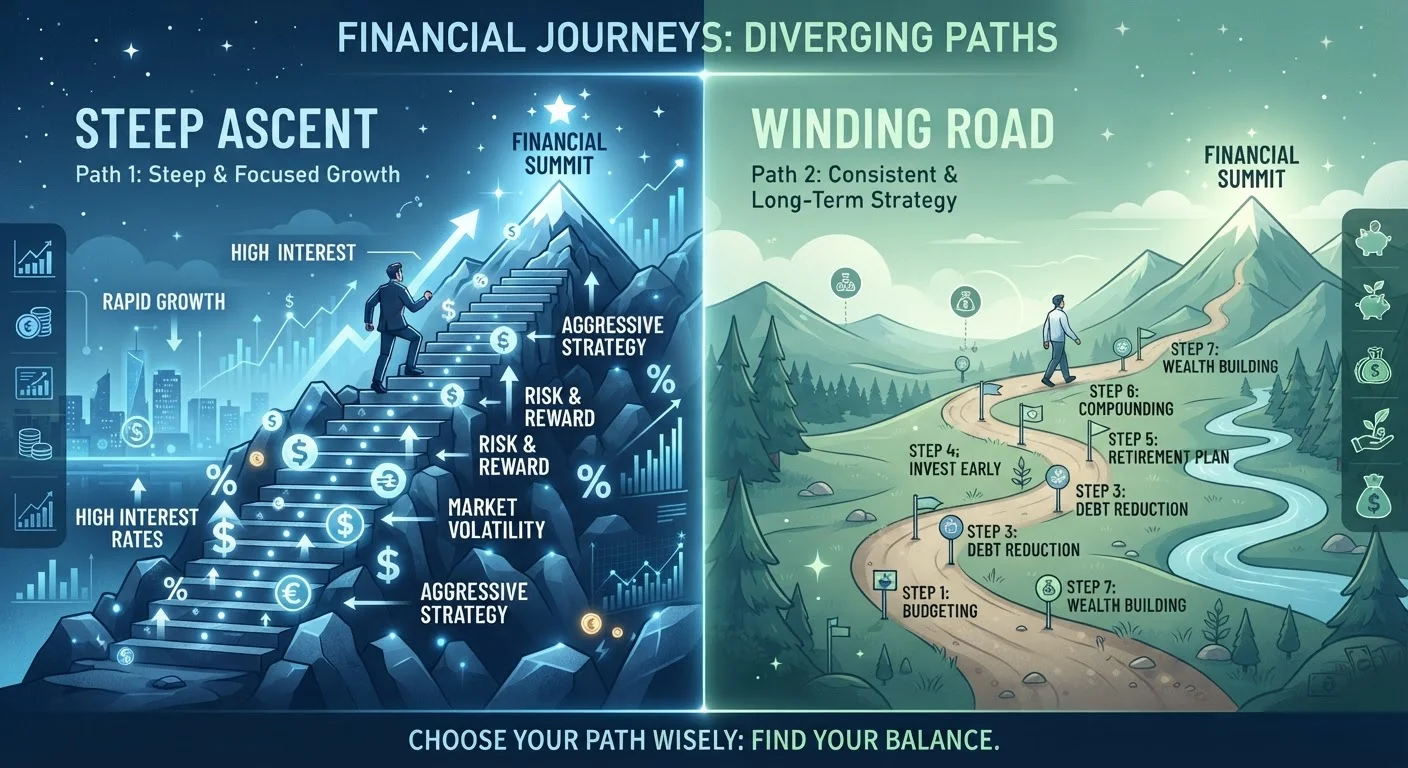
Photo: MoneyOnMind.net | Navigate Money With Clarity editorial
Key Takeaways
- The debt avalanche targets the highest-interest debt first, minimizing total interest paid over time.
- The debt snowball pays off the smallest balance first, generating motivational wins to maintain momentum.
- Mathematically, the avalanche almost always saves more money; behaviorally, the snowball keeps more people on track.
- Both methods require directing any extra monthly cash toward one prioritized debt while paying minimums on the rest.
- The best strategy is whichever one you will actually stick with through to completion.
How Each Method Works
Both the debt avalanche and debt snowball share the same core mechanic: pay the minimum on every debt each month, then direct any remaining repayment budget toward one priority debt. The difference lies entirely in how you rank that priority debt.
Debt Avalanche: Rank your debts from highest annual percentage rate (APR) to lowest. Put all extra money toward the highest-APR balance first. Once that's cleared, roll its payment into the next highest-rate debt, and so on. Because interest accrues as a percentage of your outstanding balance, eliminating high-rate debts first reduces the total dollar amount of interest you'll pay across the life of your repayment.
Debt Snowball: Rank your debts from smallest balance to largest, ignoring interest rates. Put all extra money toward the smallest balance. Once paid off, roll that freed-up payment into the next smallest balance. Each eliminated account delivers a concrete, motivating milestone - a psychological "win" that reinforces continued effort.
Neither method requires earning more money or cutting spending beyond what you're already doing. Both simply restructure the order in which existing payments are applied. For a broader repayment framework, see our comprehensive debt repayment guide.
| Criterion | Debt Avalanche | Debt Snowball |
|---|---|---|
| Priority order | Highest APR first | Smallest balance first |
| Total interest paid | Lower (mathematically optimal) | Potentially higher |
| Time to first debt payoff | Longer if high-rate debt is large | Faster - smallest balance clears first |
| Motivational structure | Delayed milestones | Frequent early wins |
| Best suits | Disciplined, numbers-driven borrowers | Habit-forming, motivation-driven borrowers |
| Complexity | Requires tracking APRs | Straightforward balance ranking |
The Real Cost Difference
The avalanche's mathematical advantage is real but varies with your specific debt mix. Consider a simplified scenario: three debts totaling $12,000 - a $5,000 balance at 22% APR, a $4,000 balance at 14% APR, and a $3,000 balance at 7% APR, with $400/month available for repayment. Avalanche order (22% → 14% → 7%) typically produces meaningfully less total interest than snowball order (7% → 14% → 22%) because you're neutralizing the highest-compounding debt earliest.
The gap narrows when your interest rates are clustered close together, or when the highest-rate debt also happens to be your smallest balance (in which case both methods agree on where to start).
~$1,000+
Potential interest savings with avalanche
Illustrative estimates based on common consumer debt scenarios suggest avalanche savings of several hundred to over a thousand dollars versus snowball ordering, depending on rate spread and balances.
33%
Adults with non-mortgage debt in the US
Federal Reserve survey data indicates roughly one-third of US adults carry non-mortgage debt balances that could benefit from a structured repayment strategy.
Importantly, the avalanche's savings only materialize if you complete the plan. A snowball that gets finished beats an avalanche that gets abandoned - a reality worth weighing honestly. For tactics that accelerate either method, explore strategic overpayments and lump-sum contributions.
Behavioral Factors That Determine Success
Financial decisions are rarely made in a purely rational vacuum. Research in behavioral economics consistently shows that people are more likely to maintain a habit when they experience regular, tangible progress - which is exactly what the snowball is engineered to deliver.
The avalanche, by contrast, may require months or years before the first account is closed, especially if your highest-rate debt carries a large balance. For some borrowers, that absence of visible milestones erodes motivation over time.
When Both Methods Start at the Same Debt
Before choosing, ask yourself honestly: Have I stuck with a multi-year financial plan before? If discipline has historically been your strength, the avalanche's math works in your favor. If past repayment attempts have stalled, the snowball's reward architecture may be the structural support you need.
You can also consider a hybrid: start with the snowball to clear one or two small accounts and build momentum, then switch to avalanche ordering once you've established the repayment habit. See a deeper breakdown of which method saves more based on different debt profiles.
Putting Your Plan Into Action
Whichever method you choose, the execution steps are the same:
- List every debt - creditor, balance, minimum payment, and APR.
- Rank them according to your chosen method (highest APR first for avalanche; smallest balance first for snowball).
- Calculate your available surplus - total monthly debt budget minus the sum of all minimums.
- Direct the surplus entirely to your priority debt each month.
- Roll payments forward - when a debt is cleared, add its former minimum to the surplus for the next debt in line.
Automate minimum payments wherever possible to avoid missed payments, which can trigger penalty rates that undermine either strategy. If you're also trying to build savings simultaneously, structuring debt repayment alongside saving is achievable with the right budget framework.
Once you've cleared debts, be aware of the patterns that cause people to re-accumulate balances - habits that undo repayment progress are worth understanding before you reach a zero balance.
This article provides general financial education only and is not personalized financial advice. Debt situations vary significantly by individual; consult a licensed financial adviser or credit counselor for guidance tailored to your circumstances.
The content on this site is for informational purposes only and is not a substitute for professional advice. Always consult a qualified professional for guidance specific to your situation.