
Short-Term vs Long-Term Financial Goals: Knowing Which to Tackle First

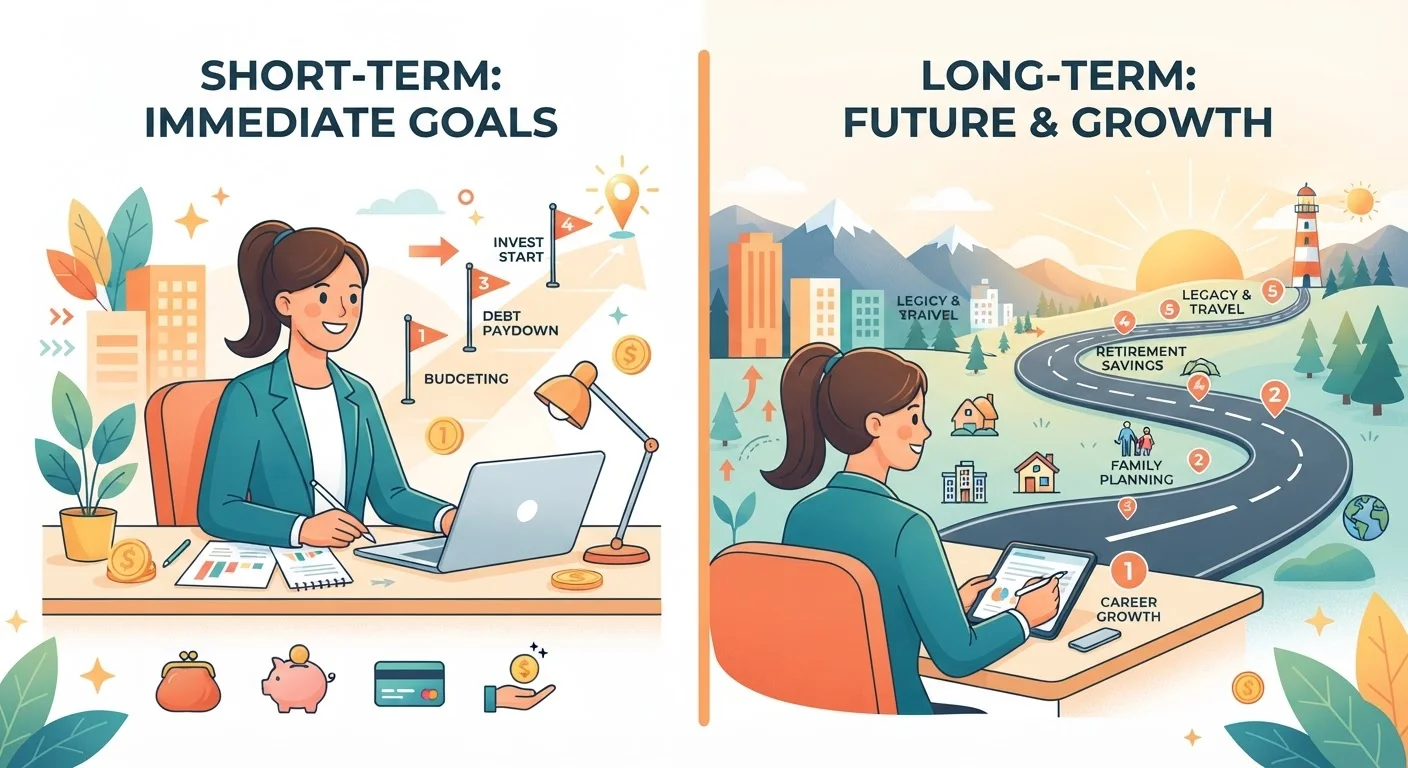
Photo: MoneyOnMind.net | Navigate Money With Clarity editorial
Key Takeaways
- Short-term goals typically span one to three years; long-term goals extend five years or more.
- Short-term wins create the stability and cash flow that make long-term investing possible.
- Sequencing matters - funding retirement before building an emergency fund often backfires.
- Both goal types should follow the SMART framework: specific, measurable, achievable, relevant, and time-bound.
- Most financial plans require working on short- and long-term goals simultaneously, not one at a time.
- A qualified financial adviser can help you prioritize based on your specific income, debts, and timeline.
What Separates a Short-Term Goal from a Long-Term One
The most practical distinction is time horizon. Short-term financial goals are targets you plan to reach within one to three years - building an emergency fund, paying off a credit card, or saving for a car down payment. Long-term financial goals are targets five or more years out - retirement savings, homeownership, or building an investment portfolio large enough to generate passive income.
The medium-term category (roughly three to five years) sits in between and might include funding a graduate degree or saving for a wedding. For sequencing purposes, treat medium-term goals more like short-term ones: the money will be needed too soon to take significant investment risk.
Understanding this vocabulary matters because the strategy shifts with the timeline. Short-term goals call for liquidity - keeping money accessible in savings accounts or short-duration instruments. Long-term goals call for growth - accepting short-term fluctuation in exchange for higher expected returns over time. For a full breakdown of key vocabulary, see Key Terms in Financial Goal Planning.
Head-to-Head: How They Compare Across Key Dimensions
It helps to place both goal types side by side before deciding how to sequence them. The table below maps the most important differences across several practical dimensions.
| Criterion | Short-Term Goals | Long-Term Goals |
|---|---|---|
| Typical time horizon | 1-3 years | 5+ years |
| Primary purpose | Stability and liquidity | Wealth accumulation and growth |
| Savings vehicle | High-yield savings, money market | 401(k), IRA, brokerage account |
| Risk tolerance | Low - capital preservation | Moderate to high - growth focused |
| Common examples | Emergency fund, debt payoff, vacation | Retirement, homeownership, financial independence |
| Feedback loop | Fast - progress visible in months | Slow - compounding takes years to show |
| Impact if skipped | Financial fragility, debt spiral risk | Delayed retirement, missed compounding |
Notice that neither goal type is superior - they serve different functions. Short-term goals protect your present; long-term goals build your future. The challenge is allocating limited income across both without neglecting either.
Why Sequencing - Not Just Balance - Is the Real Decision
Most financial advice defaults to "do both." That is technically correct but not especially useful when your budget is tight. The more productive question is: which goals get priority dollars first?
56%
Americans without 3 months' emergency savings
According to Bankrate's annual emergency savings survey, more than half of U.S. adults could not cover three months of expenses from savings alone.
~10 years
Delay cost in retirement contributions
Financial planning research consistently illustrates that starting retirement contributions a decade late can roughly halve the final balance, assuming similar rates of return.
4.7%
Average credit card interest rate range (APR floor)
Federal Reserve consumer credit data show average credit card APRs have frequently exceeded 20%, making high-interest debt reduction one of the highest-return short-term financial moves available.
A useful sequencing framework works in three layers:
- Floor first. Build a starter emergency fund (one month of essential expenses) before directing meaningful money elsewhere. Without it, any unexpected cost forces you into debt, disrupting every other goal.
- Capture free money. If your employer matches retirement contributions, contribute enough to claim the full match before accelerating debt repayment. A 100% match is a guaranteed return no savings account can replicate.
- Target high-cost debt. Once the floor is in place and you are capturing any match, redirect surplus to high-interest debt using the debt avalanche or snowball method. This is itself a short-term goal with measurable milestones.
After those three layers are handled, you can scale long-term contributions while continuing to fund near-term savings goals in parallel. This is not a rigid order - income, interest rates, and personal circumstances all matter. Consult a licensed financial adviser before making major allocation decisions.
Turning Ambitions Into Measurable Milestones
Vague intentions - "I want to save more" or "I should invest for retirement" - do not function as goals. They function as wishes. The difference is structure. Whether short- or long-term, every financial goal benefits from the SMART framework: Specific, Measurable, Achievable, Relevant, and Time-bound. Our companion piece, The SMART Framework Applied to Personal Finance Goals, walks through that structure in detail.
Applied practically: instead of "save for a house," write "save $20,000 for a down payment by December 2027 by setting aside $556 per month." That single reframe gives you a monthly action, a deadline, and a way to measure progress. The same logic applies to long-term goals - "retire comfortably" becomes "accumulate $1.2 million in retirement accounts by age 65 by contributing X per month to a tax-advantaged account."
For context on how these goals shift across your career, Financial Goal Setting Across Every Major Life Stage is worth reviewing as your circumstances evolve.
Short- and Long-Term Goals Are Not Mutually Exclusive
This article provides general financial education and is not personalized financial advice. Everyone's income, debt load, and circumstances differ. Please consult a qualified financial adviser before making significant changes to your financial plan.
The content on this site is for informational purposes only and is not a substitute for professional advice. Always consult a qualified professional for guidance specific to your situation.