
Financial Goal Setting Across Every Major Life Stage

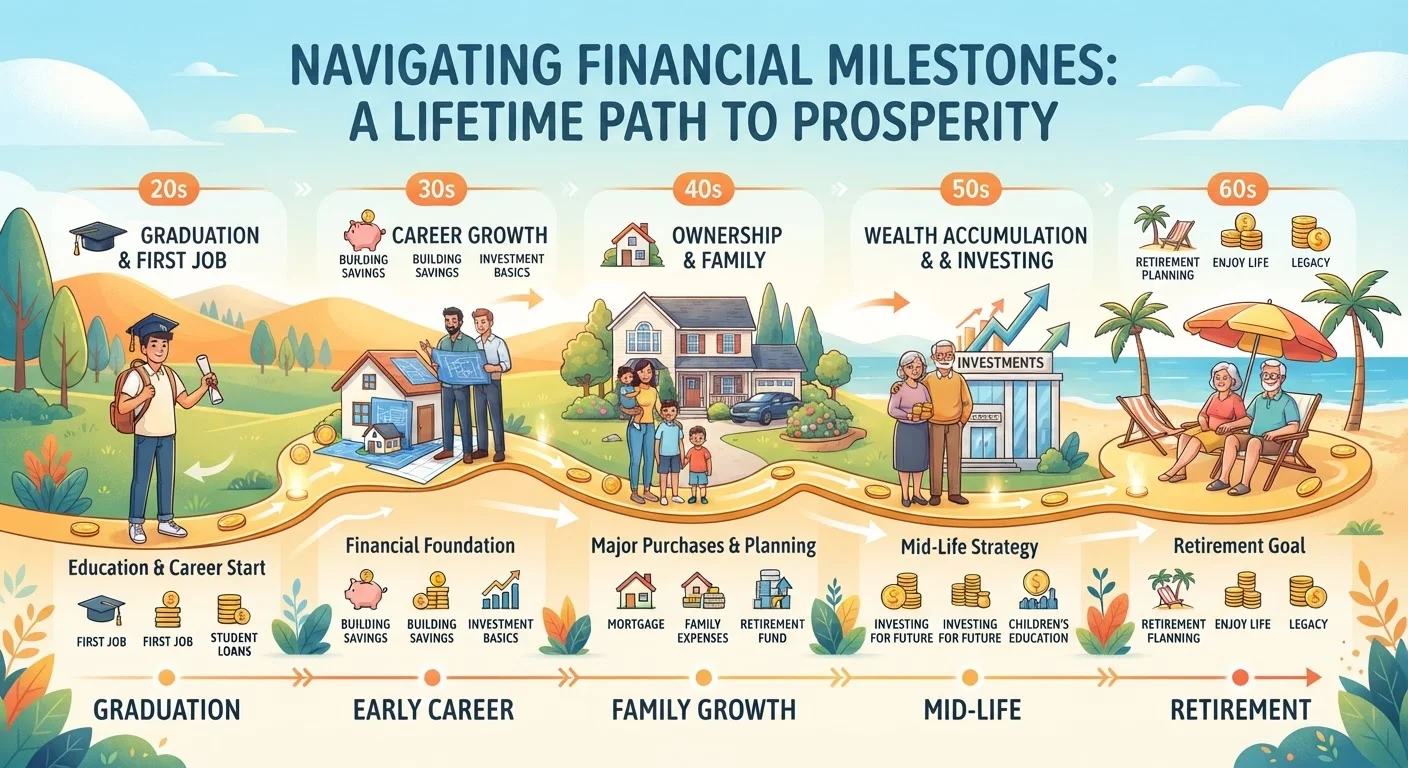
Photo: MoneyOnMind.net | Navigate Money With Clarity editorial
Key Takeaways
- Financial priorities shift meaningfully at each major life stage, requiring deliberate goal realignment.
- Early career focus belongs on emergency funds, debt reduction, and foundational retirement contributions.
- Mid-career complexity demands balancing competing goals like homeownership, family expenses, and investment growth.
- Peak earning years are the critical window for accelerating retirement savings and reducing major liabilities.
- Regular annual reviews keep your goal framework aligned with both market realities and personal life changes.
- No single framework fits every situation - consulting a licensed financial adviser helps tailor your plan.
Why Financial Goals Must Evolve With You
A financial goal that made perfect sense at 24 - paying off a credit card while sharing a one-bedroom apartment - may be almost irrelevant at 40, when a mortgage, children's education costs, and retirement savings are all competing for the same paycheck. The mechanics of goal-setting don't change, but the content of those goals absolutely must.
This guide maps the key financial priorities at each major life stage and shows how to translate shifting life ambitions into concrete, measurable milestones. Whether you're just starting out or reassessing a plan mid-career, think of this as your stage-by-stage reference. For a foundational primer, see our starting guide for young professionals before diving deeper here.
57%
Americans without a written financial plan
According to a survey by Charles Schwab, a majority of Americans manage finances without a formal written plan, underscoring how rare structured goal-setting actually is.
$1,000
Median emergency savings for many US households
Federal Reserve research has consistently shown that a significant share of US households would struggle to cover a $400 unexpected expense, highlighting the urgency of early savings habits.
15x
Growth multiplier of early retirement contributions
Compound growth over 40 years means that a dollar invested at 25 can grow substantially more than the same dollar invested at 45, illustrating the power of early career action.
Early Career (Ages 22-30): Building the Foundation
The early career years are about establishing habits and cushions that compound over time. Income is often limited and irregular, so every dollar decision carries outsized long-term weight.
Priority Goals
- Emergency fund: Aim to build three to six months of essential living expenses in a liquid savings account. This is the single most protective financial move available to a young professional.
- High-interest debt elimination: Student loans and credit card balances erode future wealth. Prioritise high-rate debts using the avalanche method (highest interest first) or the snowball method (smallest balance first) - choose whichever keeps you motivated.
- Retirement account basics: Contributing enough to capture any employer 401(k) match is effectively a guaranteed return on that money. Start there before optimising anything else.
Structure your goals using the SMART framework - Specific, Measurable, Achievable, Relevant, and Time-bound. Our guide to SMART financial goals shows exactly how to apply each criterion to real-life targets.
Automate your savings contributions before your paycheck hits your checking account. Treating savings as a non-negotiable expense - not a leftover - is the single habit that separates consistent savers from inconsistent ones.
When you receive a salary increase, immediately direct at least half of the raise toward savings or debt repayment before you adjust your lifestyle to the new income level.
Budgeting is the engine behind all of this. The Budgeting Basics hub offers practical frameworks for building a budget that actually sticks.
Mid-Career (Ages 30-45): Growing Wealth and Managing Complexity
By the mid-career stage, income typically rises - but so do financial obligations. Mortgages, childcare, insurance premiums, and lifestyle expectations often expand just as fast as earnings. Goal clarity becomes essential to avoid spreading resources too thin.
Priority Goals
- Homeownership planning: If you haven't yet purchased a home, define a realistic target purchase price, saving timeline, and down payment goal. If you own, focus on building equity strategically alongside other goals.
- Education funding: For parents, 529 college savings plans allow tax-advantaged growth for future education expenses. Early and consistent contributions reduce future strain significantly.
- Investment diversification: As investable assets grow, asset allocation matters more. Understand how your portfolio mix should shift as you age - our asset allocation guide covers the lifecycle approach in depth.
- Life and disability insurance review: Protection needs increase with dependents and debt obligations. Review coverage to ensure your family's financial stability is adequately safeguarded.
The 50/30/20 Rule as a Mid-Career Reset
Many mid-career professionals find that prioritising competing goals - home, retirement, children's education - feels paralyzing. Our Needs, Wants, and Wishes framework offers a structured method for ranking what deserves your money first.
Peak Earning Years (Ages 45-60): Accelerating Toward Retirement
Most professionals reach their highest earning potential between 45 and 60. This window is critical: it's when the gap between income and expenses can be widened most aggressively, allowing for concentrated retirement savings and debt elimination.
Priority Goals
- Maximize retirement contributions: The IRS allows catch-up contributions to 401(k) and IRA accounts for individuals 50 and older. Taking full advantage of these limits can significantly accelerate your retirement readiness.
- Eliminate the mortgage: Entering retirement without a mortgage payment substantially reduces the income you'll need each month, improving long-term sustainability.
- Long-term care planning: Costs for assisted living or in-home care are substantial and largely uncovered by Medicare. Exploring long-term care insurance options during this window - before premiums spike with age - is worth serious consideration.
- Define your retirement vision: Retirement readiness isn't just a number; it's a lifestyle projection. Estimate your post-retirement monthly expenses and work backward to identify the portfolio value needed.
Catch-Up Contributions Are a High-Stakes Opportunity
Career changers in this stage who consider returning to education should explore scholarships for working adults - targeted funding exists specifically for non-traditional learners that can reduce the financial cost of pivoting careers.
“The goal of retirement planning is not simply to accumulate a large number - it is to fund a specific lifestyle for an unknown length of time. That realization changes how people plan.”
— Wade Pfau, Professor of Retirement Income, The American College of Financial Services
Retirement and Beyond (60+): Protecting What You've Built
The financial objective shifts decisively in retirement: from accumulation to preservation and distribution. Decisions made early in this stage can have lasting consequences for how long your assets last.
Priority Goals
- Social Security timing: Delaying Social Security benefits past full retirement age (up to age 70) increases monthly payments permanently. This decision warrants careful modelling relative to your health, other income sources, and longevity estimates.
- Withdrawal sequencing: The order in which you draw down taxable, tax-deferred, and tax-free accounts affects lifetime tax liability. A licensed financial adviser or tax professional can help model the most efficient sequence for your specific situation.
- Estate planning: Wills, healthcare directives, and beneficiary designations should be reviewed and kept current. Estate planning isn't just for the wealthy - it's how you direct where your assets go.
- Healthcare cost management: Medicare, supplemental coverage, and out-of-pocket healthcare costs are among the largest retirement expenses. Understanding your coverage options is essential financial planning, not an afterthought.
This article provides general financial information for educational purposes only. It is not personalised investment, tax, legal, or financial advice. Consult a qualified, licensed financial adviser or tax professional before making decisions based on your individual circumstances.
How to Revisit and Reset Goals When Life Shifts
Life rarely follows the stage-by-stage script. Job loss, divorce, unexpected medical costs, or a sudden inheritance can render even a well-structured plan obsolete overnight. The ability to adapt is as important as the plan itself.
A structured annual review is the most reliable way to stay calibrated. Use our annual financial goals review checklist to audit progress, identify drift, and reset targets each year.
When disruption is more acute - a layoff, a new child, a major expense - a more immediate reset is needed. Our article revisiting goals after a major financial shift walks through how to reassess without scrapping your entire framework.
Finally, understand the relationship between short- and long-term goals. Addressing the right goal in the right sequence prevents a short-term crisis from permanently derailing a long-term objective. See our guide to sequencing short- and long-term goals for a practical breakdown.
Avoid Goal Stacking Without Prioritization
This article is for general informational and educational purposes only. It does not constitute personalised financial, investment, tax, or legal advice. Individual circumstances vary significantly. Please consult a licensed financial adviser, accountant, or attorney before making decisions about your own financial plan.
The content on this site is for informational purposes only and is not a substitute for professional advice. Always consult a qualified professional for guidance specific to your situation.