
Asset Allocation Across Your Lifetime: How Your Investment Mix Should Evolve

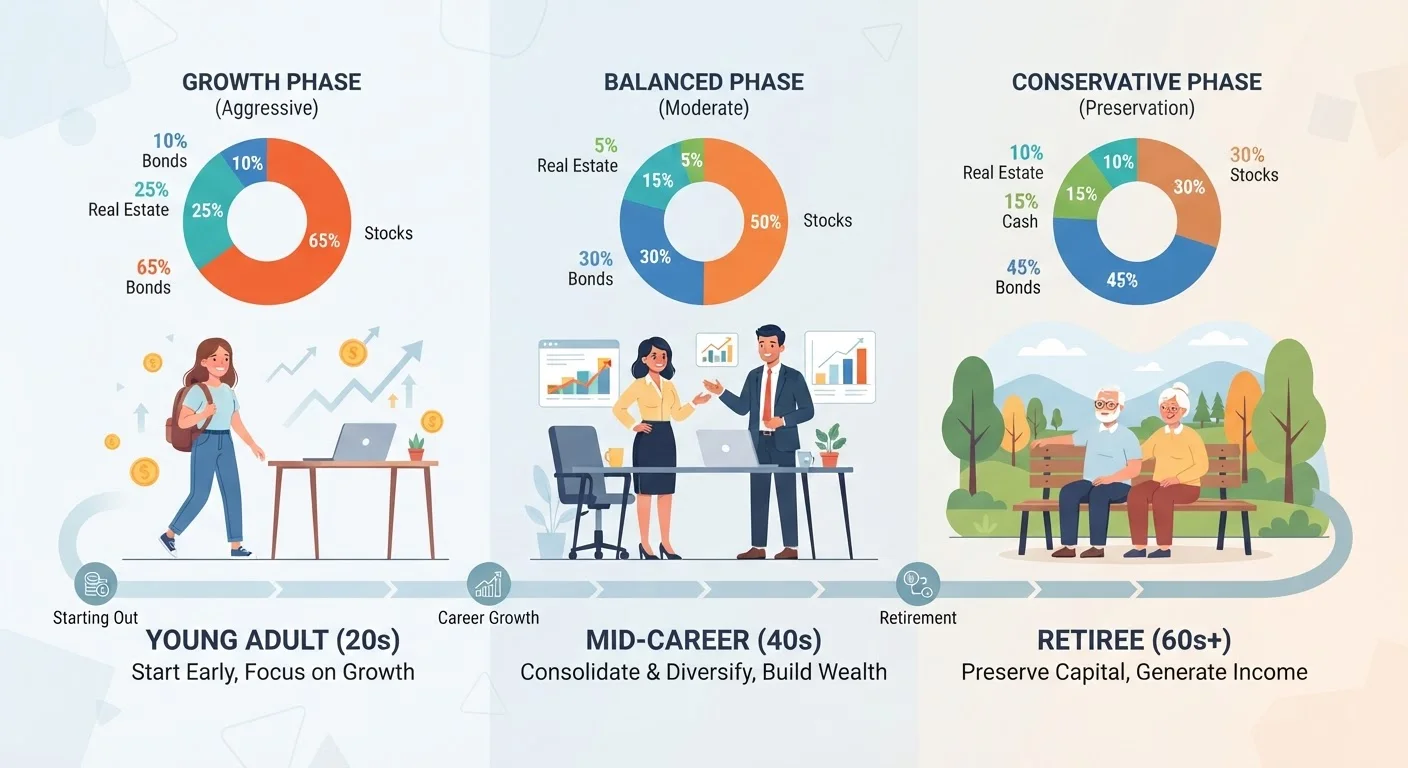
Photo: MoneyOnMind.net | Navigate Money With Clarity editorial
Key Takeaways
- Younger investors can generally afford more stocks because they have more time to recover from market downturns.
- As you approach retirement, shifting toward bonds and stable assets helps protect accumulated wealth.
- Life events - marriage, a home purchase, career change - are natural prompts to review your allocation.
- Rebalancing periodically keeps your actual mix in line with your intended target allocation.
- No single allocation formula fits everyone; risk tolerance and personal goals matter just as much as age.
Why Asset Allocation Changes Over Time
Think of your investment portfolio less like a snapshot and more like a living plan. The mix of assets that makes sense at 25 - when retirement is four decades away - looks very different from what makes sense at 55, when you're within striking distance of your goal. That gradual evolution is the core idea behind lifecycle asset allocation.
The reason age matters so much comes down to one concept: time horizon. When you have many years ahead of you, your portfolio can absorb market downturns and still recover. When you're close to needing that money, a sharp drop is far more damaging - you may not have time to wait it out. Shifting your mix as you age is essentially a form of risk management baked into your long-term strategy.
To understand the building blocks, it helps to first revisit the core principles of long-term wealth building, including how diversification and consistency work together.
~90%
Portfolio variation explained by asset allocation
Research by Brinson, Hood, and Beebower (1986, updated 1991) found that asset allocation policy explained approximately 90% of the variation in a portfolio's returns over time.
20-30 years
Average length of retirement in the US
According to Social Security Administration data, a 65-year-old today can expect to live, on average, into their mid-to-late 80s - meaning retirement portfolios must sustain income for decades.
3-4%
Average annual US inflation (long-run historical average)
Historically, US consumer price inflation has averaged roughly 3-4% annually, underscoring why even conservative investors need some growth-oriented assets to protect purchasing power.
Your 20s and Early 30s: Lean Into Growth
In your 20s, your most powerful asset isn't your savings balance - it's time. With decades before you'll need retirement income, you can afford to hold a larger share of equities (stocks), which historically offer higher long-term growth potential but also greater short-term volatility. A common starting framework for this stage is a portfolio weighted heavily toward stocks, with a smaller allocation to bonds for modest stability.
This doesn't mean ignoring risk. It means understanding that short-term market swings are less of a threat to you right now than the long-term risk of not growing your money fast enough to outpace inflation. Starting early also lets strategies like dollar-cost averaging do their work - investing regularly regardless of market conditions smooths out volatility over time.
If you're still deciding which account types to use, exploring the available investment account options is a good first step before optimizing your allocation within them.
Start Simple, Then Refine
Mid-Career: Balancing Growth With Protection
By your late 30s through your 50s, your priorities start to shift. You've likely built meaningful savings, possibly with a home, family, or other financial responsibilities in the picture. This is the stage where maintaining growth still matters - you probably have 15-25 years of working life left - but protecting what you've already built becomes increasingly important.
A gradual shift from a heavy equity weighting toward a more balanced mix, adding bonds and other stable assets, reflects this dual goal. This transition needn't happen all at once. Many investors reduce equity exposure incrementally - perhaps by a few percentage points every few years - rather than making dramatic moves.
Life milestones are also natural checkpoints. The guidance in financial goal setting across every major life stage can help you align your portfolio shifts with broader personal priorities.
Periodically reviewing and adjusting your mix is known as rebalancing. Learn more about how rebalancing works and when to do it to keep your allocation on track without overcomplicating the process.
Approaching and Entering Retirement: Prioritising Stability
In the decade leading up to retirement - and throughout it - the goal shifts from maximum accumulation to capital preservation and income generation. A portfolio that's heavy in equities could suffer a sharp loss right before or after you retire, forcing you to sell investments at a loss to cover expenses. This is sometimes called sequence-of-returns risk.
Increasing your allocation to bonds, dividend-generating assets, and cash equivalents reduces this exposure. That said, even retirees usually need some equity exposure to ensure their savings can outpace inflation over a retirement that could last 20-30 years. The right balance depends on your spending needs, other income sources like Social Security or pensions, and your personal comfort with volatility.
For those managing multiple account types - a 401(k), IRA, and taxable brokerage account - account stacking strategies can help you decide which assets to hold in which accounts for tax efficiency alongside your allocation decisions.
If you're ready to translate these principles into a concrete plan, see our step-by-step guide to building a long-term portfolio from scratch.
This article is for general informational and educational purposes only and does not constitute personalized financial, investment, tax, or legal advice. Asset allocation strategies involve risk, including potential loss of principal. Please consult a qualified, licensed financial adviser before making decisions about your own investment portfolio.
Frequently Asked Questions
The content on this site is for informational purposes only and is not a substitute for professional advice. Always consult a qualified professional for guidance specific to your situation.