
Active Investing vs. Passive Investing: Two Philosophies, Very Different Demands

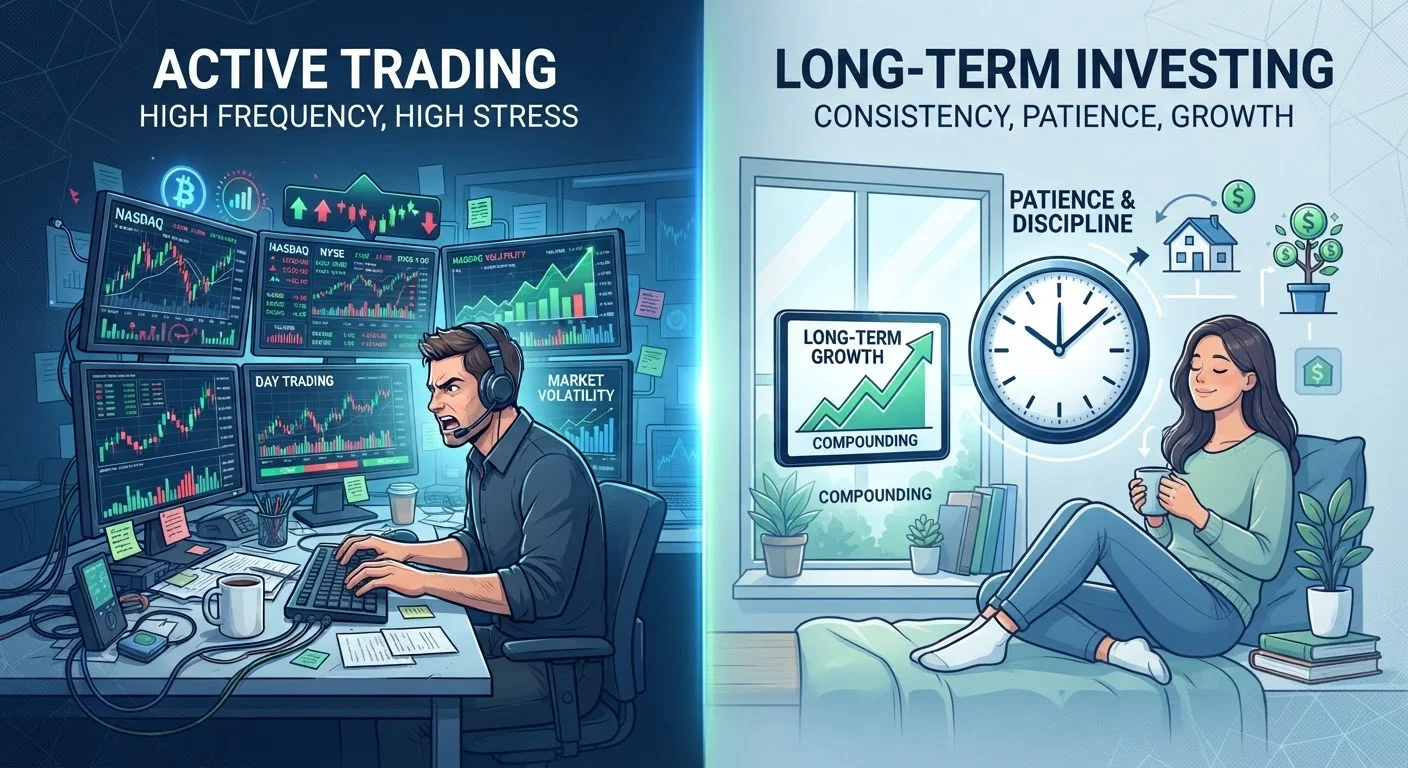
Photo: MoneyOnMind.net | Navigate Money With Clarity editorial
Key Takeaways
- Active investing aims to beat the market; passive investing aims to match it at lower cost.
- Active strategies typically carry higher fees and require more time, research, and decision-making.
- Research consistently shows most actively managed funds underperform their benchmark index over the long run.
- Passive investing through index funds offers diversification and simplicity, but cannot outperform the market by design.
- Neither approach is universally superior - your goals, time, and risk tolerance all matter.
What Each Philosophy Actually Means
Active investing is the practice of making deliberate buy and sell decisions - selecting individual stocks, bonds, or other securities with the goal of outperforming a market benchmark, such as the S&P 500. Active investors (or fund managers acting on their behalf) analyze company financials, economic trends, and market signals to decide when to enter or exit positions.
Passive investing, by contrast, involves tracking a market index rather than trying to beat it. Instead of picking individual securities, passive investors hold a representative slice of the whole market - typically through index funds or exchange-traded funds (ETFs) - and ride the market's overall performance over time. The strategy is built on the observation that markets are largely efficient, meaning prices already reflect available information.
These aren't just different tactics - they reflect genuinely different beliefs about how markets work and what investors can realistically achieve. For a deeper look at how these philosophies play out in specific fund structures, see our comparison of index funds and actively managed funds.
Key Differences: Cost, Effort, and Performance
The practical gap between active and passive investing shows up most clearly in three areas: what you pay, what you do, and what results you can reasonably expect.
| Criterion | Active Investing | Passive Investing |
|---|---|---|
| Goal | Beat the market benchmark | Match the market benchmark |
| Typical fees (expense ratio) | 0.5%-1.5%+ annually | 0.03%-0.20% annually |
| Time commitment | High - ongoing research needed | Low - set-and-monitor approach |
| Diversification | Varies by strategy | Broad by design |
| Long-run outperformance likelihood | Minority of funds succeed | Not possible by design |
| Tax efficiency | Lower - more frequent trading | Higher - fewer taxable events |
Cost is one of the most concrete distinctions. Active funds pay research analysts, portfolio managers, and trading desks - costs passed to investors through higher expense ratios. Passive index funds, by contrast, require minimal management, keeping fees low. Over decades, even a 1% annual fee difference compounds into a substantial drag on returns.
Performance is where the evidence is most striking. According to S&P Dow Jones Indices' SPIVA reports - a well-regarded ongoing research series - the majority of actively managed US equity funds have underperformed their benchmark index over 10- and 15-year periods. This doesn't mean active outperformance is impossible, but it is the exception rather than the rule, even among professional managers.
~85%
Active US equity funds underperforming their index
According to S&P Dow Jones Indices' SPIVA US Scorecard, roughly 85% of active large-cap US equity funds underperformed the S&P 500 over a 15-year period.
1%
Annual fee difference impact over 30 years
A 1% higher annual expense ratio on a $50,000 portfolio can reduce total value by tens of thousands of dollars over a 30-year investment horizon, illustrating the compound cost of fees.
That said, passive investing has a structural limitation: it can never beat the market. By design, it captures market returns minus a small fee. For investors comfortable with market-level outcomes, this is a reasonable trade-off. For those seeking to generate alpha - returns above the market average - active strategies remain the only avenue, albeit a challenging one.
Time, Temperament, and What Suits You
Beyond costs and returns, the right approach depends heavily on your personal circumstances. Active investing demands ongoing attention: reviewing earnings reports, tracking macroeconomic data, managing position sizes, and making timely decisions. For most working professionals, this time commitment is a real constraint, not an abstract one.
Passive investing requires far less ongoing involvement. Once you've chosen a diversified set of index funds and set up a regular contribution schedule - a strategy often paired with dollar-cost averaging - there's little to do except stay the course through market fluctuations. This simplicity is a genuine advantage, not a compromise.
It's also worth noting that the two approaches aren't mutually exclusive. Some investors hold a core passive portfolio while reserving a small portion for individual stock positions - a hybrid approach sometimes called a "core-satellite" strategy. The choice of account type also plays a role; understanding your options is a helpful starting point, and our guide to investment account types covers the fundamentals clearly.
Neither Approach Eliminates Market Risk
Evidence also suggests that investor behavior often matters as much as strategy. Research in behavioral economics shows that active investors who trade frequently are more exposed to emotional decision-making - buying high in excitement and selling low in fear. Patient, long-term investors tend to avoid these costly mistakes.
This article is for general informational purposes only and does not constitute personalised financial or investment advice. Investing involves risk, including the possible loss of principal. Past performance does not guarantee future results. Please consult a qualified financial adviser before making investment decisions based on your individual circumstances.
The content on this site is for informational purposes only and is not a substitute for professional advice. Always consult a qualified professional for guidance specific to your situation.