
Index Funds vs. Actively Managed Funds for Long-Term Investors

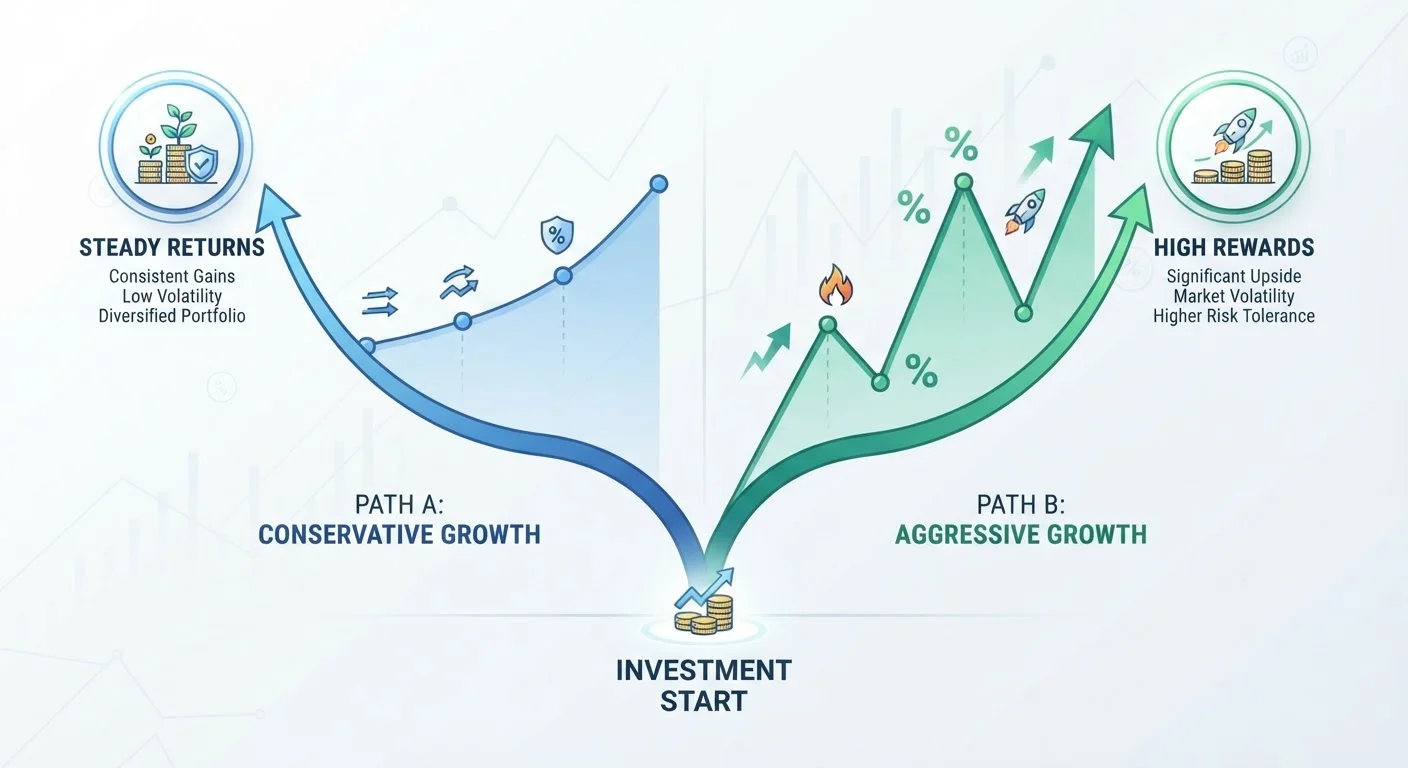
Photo: MoneyOnMind.net | Navigate Money With Clarity editorial
Key Takeaways
- Index funds typically carry significantly lower expense ratios than actively managed funds, reducing the drag on long-term returns.
- Most actively managed funds have historically underperformed their benchmark index over a 15-year period, net of fees.
- Index funds offer automatic diversification by tracking a market index such as the S&P 500.
- Actively managed funds depend on a fund manager's skill and judgment, introducing additional manager risk.
- For most long-term, beginner investors, a low-cost index fund strategy aligns well with patience-driven wealth building.
- Neither approach is universally superior - your choice should reflect your goals, timeline, and risk tolerance.
What Are Index Funds and Actively Managed Funds?
An index fund is a type of mutual fund or exchange-traded fund (ETF) designed to replicate the performance of a specific market index - such as the S&P 500 or the Total Stock Market Index. Rather than selecting individual securities, the fund simply holds the same assets in the same proportions as the index it tracks. No active decision-making is involved; the portfolio changes only when the underlying index changes.
An actively managed fund, by contrast, employs a professional portfolio manager or team whose job is to research, select, and continuously adjust the fund's holdings in an attempt to outperform a designated benchmark. These managers make ongoing buy and sell decisions based on analysis, economic forecasts, and investment judgment.
For a deeper grounding in the broader philosophies behind these two approaches, see our comparison of active and passive investing philosophies.
How Do Costs Compare?
Cost is one of the starkest differences between these two fund types. Index funds are generally far cheaper to operate because no active research team or high-frequency trading is required. Their expense ratios - the annual percentage of assets deducted as fees - commonly range from 0.03% to 0.20%.
Actively managed funds must cover research analysts, portfolio managers, and higher transaction costs, pushing their expense ratios to a typical range of 0.50% to 1.25% or more. Over a 30-year investment horizon, even a seemingly small annual fee difference compounds into a substantial gap in final portfolio value.
| Criterion | Index Funds | Actively Managed Funds |
|---|---|---|
| Typical Expense Ratio | 0.03% - 0.20% | 0.50% - 1.25%+ |
| Management Style | Passive - tracks an index | Active - manager makes decisions |
| Diversification | Broad, automatic | Varies by fund strategy |
| Benchmark Outperformance Potential | Matches the index, net of fees | Possible, but not guaranteed |
| Manager Risk | None - no active decisions | Present - depends on manager skill |
| Effort Required from Investor | Very low - buy and hold | Low to moderate - monitor fund changes |
| Tax Efficiency | Generally higher | Generally lower due to turnover |
These differences matter because fees are deducted regardless of fund performance. A fund must consistently outperform its benchmark by enough to cover its costs - and then some - before it delivers superior net returns to investors.
~85%
Active large-cap funds underperforming S&P 500 over 15 years
According to S&P Dow Jones Indices' SPIVA US Scorecard, approximately 85% of actively managed large-cap US equity funds underperformed the S&P 500 over a 15-year period, net of fees.
1%
Annual fee difference eroding returns over 30 years
A 1% higher annual expense ratio on a $10,000 investment earning 7% annually results in roughly $32,000 less after 30 years, illustrating the compounding impact of fees.
0.03%
Lowest expense ratios available on broad index funds
Some broad market index funds carry expense ratios as low as 0.03% annually, making them among the most cost-efficient investment vehicles available to retail investors.
Long-Term Performance: What the Evidence Shows
Decades of performance data present a consistent, if humbling, picture for active management. Research from S&P Dow Jones Indices' SPIVA (S&P Indices Versus Active) reports consistently finds that the majority of actively managed equity funds underperform their benchmark index over longer periods, particularly after fees are accounted for. The percentage of underperforming active funds typically increases the longer the time horizon measured.
That said, some actively managed funds do outperform over sustained periods - the challenge is identifying them in advance, before that outperformance occurs. Past outperformance has not reliably predicted future outperformance in broad research.
For context on why staying patient and invested tends to matter more than fund selection alone, see why patient investors often outperform active traders.
Active Outperformance Does Happen - But Is Hard to Predict
Risk, Diversification, and the Long-Term Investor
Index funds provide built-in diversification by design. A fund tracking the S&P 500, for example, holds ownership stakes across 500 large US companies spread across sectors - automatically reducing the impact of any single company's poor performance.
Actively managed funds can be more concentrated, either by design or as a result of high-conviction bets by the portfolio manager. This concentration can amplify gains when calls are correct - but equally amplify losses when they are not. Additionally, manager risk is a real consideration: if a star manager leaves the fund, the strategy and results may shift meaningfully.
For long-term investors building foundational wealth, understanding how any fund fits into your broader asset allocation is critical. Our guide on asset allocation across your lifetime explores how your investment mix should evolve as you age and your goals shift.
If you are still building a foundation in investing concepts, our complete reference guide for beginner long-term investors is a useful starting point.
This article is for general informational and educational purposes only and does not constitute personalised financial, investment, tax, or legal advice. All investing involves risk, including the possible loss of principal. Past performance does not guarantee future results. Consult a licensed financial adviser before making investment decisions specific to your situation.
The content on this site is for informational purposes only and is not a substitute for professional advice. Always consult a qualified professional for guidance specific to your situation.