
Understanding Investment Fees and Why They Quietly Erode Returns

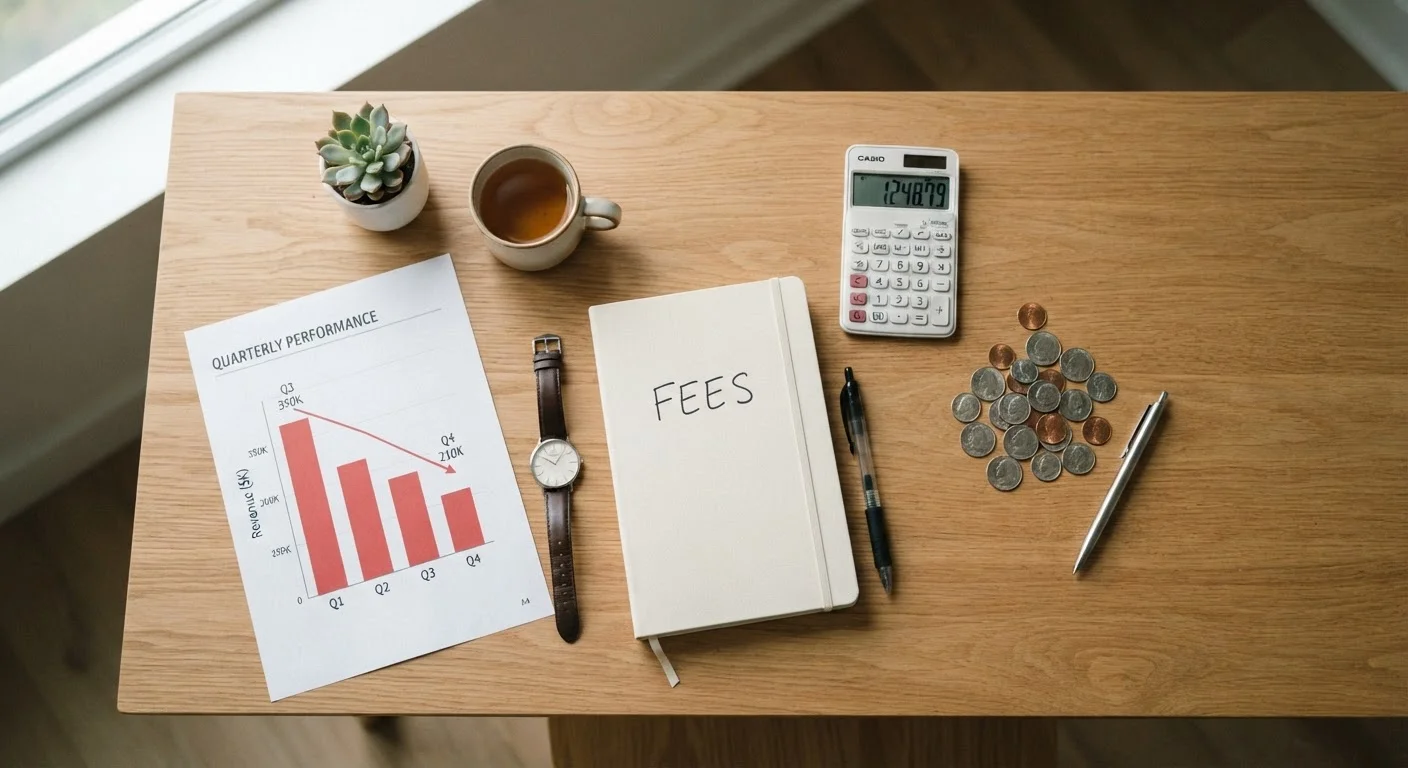
Photo: MoneyOnMind.net | Navigate Money With Clarity editorial
Key Takeaways
- Investment fees reduce both your current balance and the future compounding power of that money.
- Expense ratios, management fees, and trading commissions are the most common fee types investors encounter.
- A difference of even 0.5% in annual fees can translate into tens of thousands of dollars lost over decades.
- Passively managed index funds typically carry significantly lower expense ratios than actively managed funds.
- Always review a fund's prospectus or fee disclosure before investing to understand the full cost structure.
The Types of Investment Fees You're Likely to Encounter
Investment fees aren't always visible on a statement. Some are embedded in fund structures, others charged by advisers, and others triggered only when you trade. Understanding each category is the first step to evaluating what you're actually paying.
Expense Ratios
If you invest in a mutual fund or exchange-traded fund (ETF), you pay an expense ratio - an annual fee automatically deducted from the fund's assets. It covers the fund's operating costs: portfolio management, administration, and marketing. A fund with a 0.75% expense ratio takes $75 per year from every $10,000 you hold. Passively managed index funds, which simply track a market benchmark, tend to have much lower expense ratios than actively managed funds, where a team of analysts makes buy and sell decisions.
Advisory and Management Fees
If you work with a financial adviser or use a robo-adviser platform, you'll likely pay an assets under management (AUM) fee - typically ranging from roughly 0.25% for automated services to around 1% or more for human advisers. This fee is charged on top of whatever the underlying funds already cost.
Trading Commissions
Each time you buy or sell a security, some platforms charge a commission. While many U.S. brokerages now offer commission-free trading on stocks and ETFs, certain product types - like options or some mutual funds - may still carry per-transaction fees. Frequent trading can accumulate these costs quickly.
Sales Loads
Some mutual funds charge a sales load - a commission paid when you buy (front-end load) or sell (back-end load) shares. A 5% front-end load on a $5,000 investment means only $4,750 actually gets invested from day one. No-load funds avoid this structure entirely.
Investment Fees vs. Bank Fees: A Key Difference
How Fees Compound Against You Over Time
The most important thing to understand about investment fees is that they don't just reduce your balance - they reduce the base on which future returns are calculated. That's the compounding problem.
Consider two hypothetical investors who each start with $20,000 and earn the same gross annual return of 7%. One holds a fund with a 0.10% expense ratio; the other holds a comparable fund with a 1.00% expense ratio. After 30 years, the difference in ending balances isn't $1,800 (30 years × $600) - it's substantially larger, because the higher-fee investor has been compounding on a shrinking base the entire time.
~$30,000+
Potential 30-year fee drag on a $20,000 portfolio
Illustrative estimates based on a 1% vs. 0.10% annual fee difference on a $20,000 portfolio growing at 7% gross annually - showing the compounding impact of higher fees over time.
0.05%-0.10%
Typical expense ratios for broad-market index funds
Many passively managed index funds available to U.S. retail investors carry expense ratios in this range, according to publicly available fund prospectuses.
~1%
Common AUM fee for traditional financial advisers
A frequently cited benchmark in industry discussions; actual adviser fees vary by firm, service level, and account size.
This is why even a seemingly small fee difference matters enormously over a decades-long investment horizon. The damage is invisible year to year but significant in aggregate.
For context on how fees in financial accounts can erode value broadly - not just in investment accounts - see how bank fees drain balances over time.
How to Evaluate and Minimize Investment Fees
You don't need to eliminate all fees - some are reasonable for the service provided. What matters is being intentional about what you pay and whether it's justified.
Read the Fund Prospectus or Fee Disclosure
Every registered fund is required to disclose its expense ratio and other costs in its prospectus. Before investing in any fund, locate this document and find the fee table. It will show you the total annual operating expenses as a percentage.
Compare Expense Ratios Within the Same Category
If two funds track the same index, the one with the lower expense ratio will, all else equal, deliver a higher net return. Look for funds that clearly disclose their costs and benchmark them against similar products in that category.
Understand the Full Cost Stack
Your total investment cost is the sum of all layers: the fund's expense ratio, plus any advisory fee, plus any transaction costs. A 0.25% robo-adviser fee on top of a 0.50% fund expense ratio means you're paying 0.75% annually before you've earned a dollar.
Build the Habit of Checking the Full Fee Stack
Learning to spot and evaluate fees is part of the broader skill set that helps new investors avoid common missteps. See why new investors derail their own progress for a deeper look at the habits that quietly undermine returns.
This article is for general informational and educational purposes only and does not constitute personalized financial, investment, tax, or legal advice. Investment involves risk, including the possible loss of principal. Past performance does not guarantee future results. Consult a qualified financial adviser or tax professional before making decisions based on your specific circumstances.
Frequently Asked Questions
The content on this site is for informational purposes only and is not a substitute for professional advice. Always consult a qualified professional for guidance specific to your situation.