
Fixed vs. Variable Interest Rates: Choosing the Right Structure for Your Loan

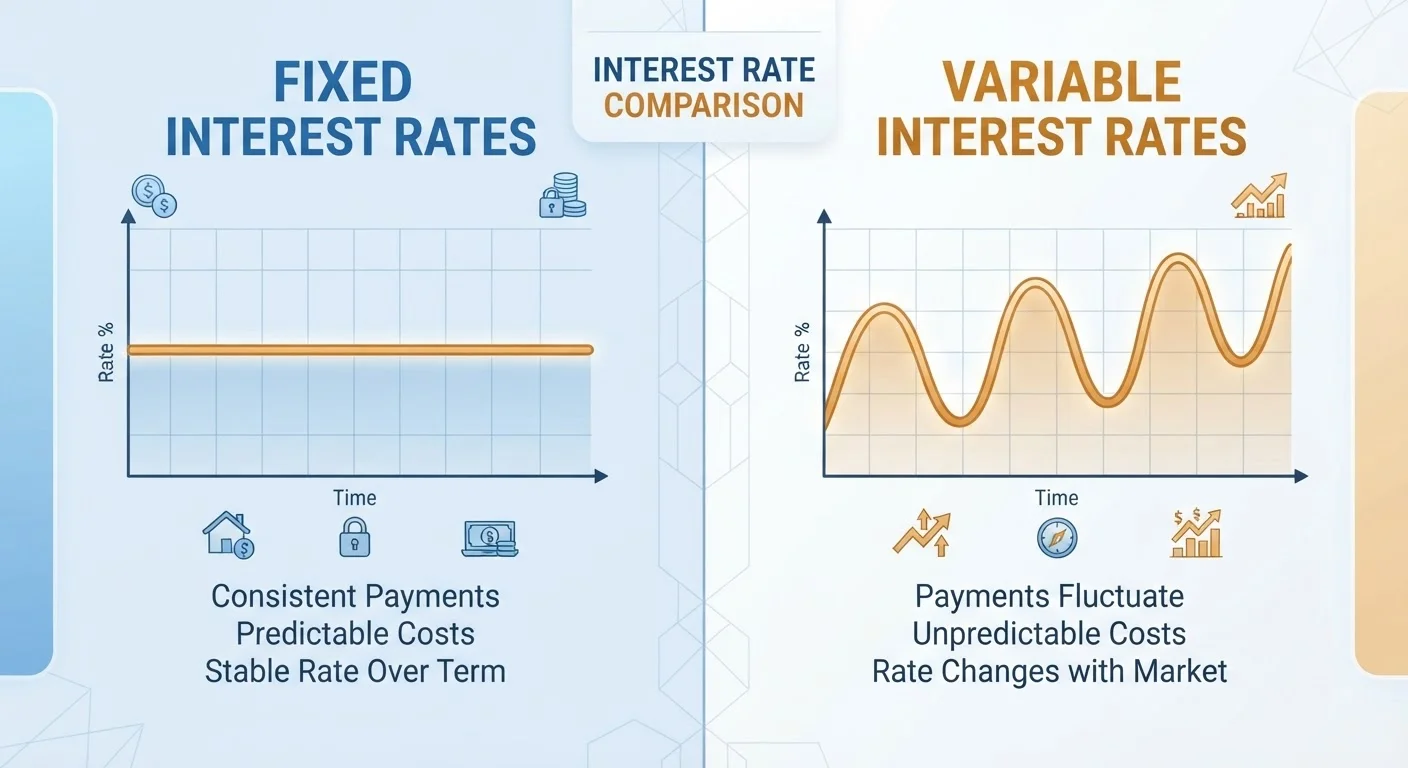
Photo: MoneyOnMind.net | Navigate Money With Clarity editorial
Key Takeaways
- Fixed rates lock in your interest for the life of the loan, making monthly payments predictable and stable.
- Variable rates fluctuate with market benchmarks, meaning your payment can rise or fall over time.
- Choosing between them depends on your loan term, risk tolerance, and whether rates are currently high or low.
- Shorter loan terms reduce variable-rate risk; longer terms make fixed-rate predictability more valuable.
- Always consult a licensed financial adviser before committing to a loan structure that affects your long-term finances.
What Fixed and Variable Rates Actually Mean
When a lender quotes you an interest rate, that rate determines how much you pay to borrow money beyond the principal. The key question is whether that rate stays the same for the entire loan term or adjusts over time.
A fixed interest rate is set at origination and never changes. If you lock in at 7%, every payment for the life of the loan reflects that 7% - regardless of what happens in the broader economy.
A variable interest rate (also called an adjustable rate) is tied to a financial benchmark, commonly the SOFR or the prime rate. Lenders add a margin on top of that benchmark, and as the benchmark moves, your rate - and your monthly payment - moves with it.
Understanding this distinction is foundational before signing any loan agreement. For more context on how loan structure affects your total cost, see why repayment terms matter as much as the rate.
Comparing the Two Structures Side by Side
Each rate type involves real trade-offs across predictability, cost potential, and risk exposure. The table below outlines the key differences to help you weigh both options against your situation.
| Fixed Rate | Variable Rate | |
|---|---|---|
| Payment predictability | Completely stable throughout | Fluctuates with benchmark rate |
| Starting rate | Typically higher than variable | Often lower at origination |
| Rate change risk | None - locked at origination | Can rise significantly over time |
| Best loan term fit | Long-term loans (5+ years) | Short-term loans (1-3 years) |
| Budget planning ease | Very easy - same payment monthly | Harder - payment can change |
| Benefits when market rates fall | No - requires refinancing | Yes - rate drops automatically |
| Risk tolerance required | Low - suits cautious borrowers | Higher - suits flexible borrowers |
One important nuance: variable rates often start lower than fixed rates on the same loan. That initial discount can be attractive, but it's not guaranteed savings - it's a starting point that can shift.
When Fixed Rates Make More Sense
Fixed rates are generally the stronger choice when:
- Your loan term is long. The longer the repayment period, the more exposure you carry to rate volatility. A 30-year mortgage with a variable rate is a very different risk profile than a 2-year personal loan.
- You're on a tight monthly budget. If your income doesn't leave much room for payment increases, a fixed rate protects you from the unexpected. It makes budgeting straightforward - the same payment, every month.
- Rates are historically low when you borrow. Locking in a low fixed rate when the market is favorable can save significantly over the life of the loan compared to riding variable fluctuations upward.
Fixed rates also reduce cognitive overhead. You don't need to track rate announcements or wonder whether your next statement will differ from the last.
Lock In During Low-Rate Periods
When Variable Rates Can Work in Your Favor
Variable rates aren't inherently riskier in every scenario. They can be the smarter option under these conditions:
- Short loan terms. If you plan to repay in two to three years, there's less window for rates to rise dramatically. The lower initial rate can translate into genuine savings before volatility has a chance to compound.
- You expect rates to decline. Variable rates pass falling benchmark rates on to borrowers automatically - unlike fixed rates, which require refinancing to capture lower market conditions. If rates are high now and expected to ease, a variable structure may result in lower costs over time.
- You have financial flexibility. If your income is stable, growing, or you have reserves to absorb higher payments in a rising-rate environment, the initial cost advantage may outweigh the risk.
It's worth comparing how variable payment structures interact with your overall budget. The distinction between fixed and variable expenses in your monthly spending is directly relevant here.
Variable Rates Have No Payment Cap by Default
Making the Decision: Key Questions to Ask Yourself
Before choosing a rate structure, work through these questions honestly:
- How long is my loan term? Longer terms amplify variable-rate risk and increase the value of rate certainty.
- How stable is my income? Irregular or growth-stage income may not absorb payment increases comfortably.
- Where are interest rates in the current cycle? Locking in during a rate peak could mean paying more than necessary; variable structures during high-rate environments may be positioned to benefit from future decreases.
- Could I refinance if needed? Refinancing a variable-rate loan to a fixed rate is possible but comes with costs and qualification requirements of its own.
This decision intersects with broader loan structure choices. See how collateral affects your loan terms and rate options and how loan length reshapes your total cost for a fuller picture before you commit.
This article is for general informational purposes only and does not constitute personalised financial or legal advice. Loan terms, rate structures, and eligibility vary by lender and individual circumstances. Consult a licensed financial adviser before making borrowing decisions.
The content on this site is for informational purposes only and is not a substitute for professional advice. Always consult a qualified professional for guidance specific to your situation.