
When to Prioritise Debt Over Saving - and When Not To

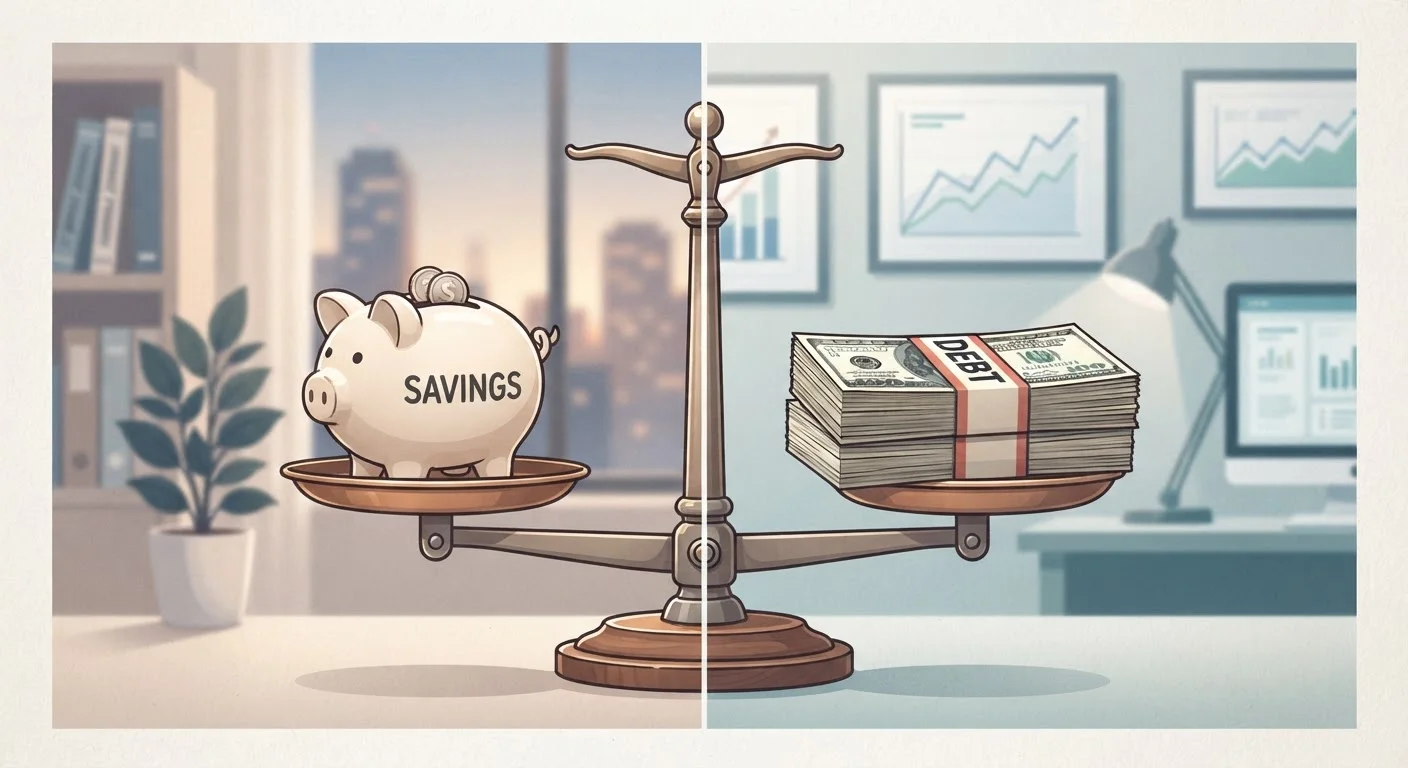
Photo: MoneyOnMind.net | Navigate Money With Clarity editorial
Key Takeaways
- High-interest debt (above ~7%) almost always costs more than savings can earn - tackle it first.
- A small emergency fund should exist before aggressively paying down debt, not after.
- Employer 401(k) matches are effectively free money - capture them even while repaying debt.
- The optimal strategy depends on interest rates, income stability, and your specific goals.
- Most people benefit from a hybrid approach rather than an all-or-nothing choice.
The Core Trade-Off: Interest Rates as the Deciding Factor
The debt-versus-saving debate is, at its heart, a math problem. Every dollar directed at debt saves you the interest rate on that debt. Every dollar saved earns whatever return your account or investment produces. When those two numbers differ significantly, the right answer becomes clear.
A widely used rule of thumb: if your debt's interest rate exceeds roughly 6-7%, paying it down delivers a better guaranteed return than most savings vehicles can reliably match. Credit cards averaging 20%+ APR fall decisively into this camp. Federal student loans at 5-6% or a fixed mortgage at 4% are less clear-cut and often warrant a different approach.
Think of it this way - eliminating a 22% APR credit card balance is equivalent to earning a guaranteed 22% return, which no savings account or low-risk investment can replicate. That guaranteed nature matters: market returns fluctuate, but the interest your lender charges does not.
| Prioritise Debt Repayment | Hybrid Approach | Prioritise Saving | |
|---|---|---|---|
| Best suited for | High-interest debt (>7% APR) | Mixed-rate debt with financial goals | Low-rate debt, stable income |
| Interest cost impact | Reduces high interest quickly | Moderately reduces interest | Minimal if rates are low |
| Emergency fund risk | Higher without a buffer | Balanced with starter fund | Lower with full cushion |
| Retirement growth | Delayed unless match captured | Match captured, some growth | Maximised contributions |
| Psychological benefit | Debt-free relief sooner | Progress on multiple fronts | Security from growing savings |
| Flexibility | Less flexible mid-plan | Most flexible | May extend debt repayment timeline |
When Saving Should Come First (or at Least Alongside)
Even with significant debt, two savings priorities deserve attention before you commit every spare dollar to repayment.
1. A Starter Emergency Fund
Without any liquid reserve, an unexpected expense - a car repair, a medical bill - forces you back onto high-interest credit. A common benchmark is $1,000 to one month of essential expenses as an initial buffer. This isn't the full three-to-six month fund advisers recommend for long-term stability; it's a firewall that prevents debt from spiralling. Once high-interest balances are gone, you can rebuild to a fuller cushion.
2. An Employer 401(k) Match
If your employer matches retirement contributions - say, 50 cents per dollar up to 6% of salary - not contributing enough to capture that match means leaving guaranteed compensation on the table. That match represents an immediate 50-100% return on those dollars, which almost always outweighs even high-rate debt payoff in the short run. Contribute at least enough to claim the full match, then redirect remaining funds to debt.
For a deeper look at structuring goals on both fronts simultaneously, see how to pay off debt while still saving.
Automate the Split Before You Decide
The Hybrid Framework: A Practical Decision Order
Rather than treating this as binary, a sequenced framework helps most borrowers make consistent, rational decisions with each dollar of discretionary income:
- Build a starter emergency fund (~$1,000 or one month of essentials).
- Contribute enough to your 401(k) to capture any employer match - not a dollar more yet.
- Pay off all high-interest debt (generally above 6-7% APR) using a structured method such as the avalanche or snowball approach. See which repayment order saves more for a detailed comparison.
- Expand your emergency fund to three to six months of expenses.
- Increase retirement and investment contributions now that high-cost debt is cleared.
Low-rate debt - a federal student loan at 4-5%, or a mortgage - can reasonably be repaid on schedule while simultaneously building savings and investments. The math often favours keeping these loans and investing the difference, though personal risk tolerance, income stability, and psychological preference all legitimately affect which path you choose.
For context on how to balance debt repayment with forward-looking financial goals, our planning hub explores how these two priorities can coexist.
20%+
Average US credit card APR
The Federal Reserve has reported average credit card interest rates consistently above 20% in recent years, making high-rate debt extremely costly to carry.
~56%
Americans with no emergency savings buffer
Surveys by Bankrate have found that a substantial share of US adults could not cover a $1,000 emergency expense from savings alone.
3-6 months
Recommended emergency fund target
Most personal finance guidance suggests maintaining three to six months of essential living expenses in accessible, liquid savings.
Psychological Factors That Legitimately Shift the Calculus
Financial decisions aren't purely mathematical. Several real-world factors can reasonably tip you toward one approach over the other, even when the numbers don't perfectly support it:
- Income volatility: Freelancers or commission-based earners may benefit from a larger emergency fund relative to their debt payoff pace, since a missed payment can trigger penalties that undo prior progress.
- Debt-related stress: Research consistently shows financial anxiety affects decision-making capacity. If carrying debt impairs your ability to function at work or maintain relationships, the psychological cost of debt is real - and accelerating repayment may be rational even when the pure math says otherwise.
- Motivation and consistency: A strategy you can sustain for two years beats a theoretically optimal plan abandoned after four months. Both the avalanche and snowball repayment paths account for this - choose the one that keeps you engaged.
This article provides general financial information and education only. For decisions specific to your income, debt profile, and goals, consult a qualified financial adviser or credit counsellor.
The content on this page is for informational purposes only and does not constitute personalised financial, tax, or legal advice. Individual circumstances vary - speak with a licensed financial professional before making significant decisions about debt repayment or saving strategies.
The content on this site is for informational purposes only and is not a substitute for professional advice. Always consult a qualified professional for guidance specific to your situation.